Paris Journal 2010 – Barbara Joy Cooley Home: barbarajoycooley.com
Photos
and thoughts about Paris
Sign
my guestbook. View
my guestbook. 2009 Paris Journal ← Previous Next
→ ← Go
back to the beginning
|
On Sunday, when we were all packed up with various assorted bags, Tom went to get a taxi while I waited in the porte cochère with the luggage. It wasn’t long before I could hear a diesel engine humming just beyond the porte cochère’s door, and I decided that this sound had to be a fuel-efficient hatchback taxi. I pushed the button to unlock the door and voila! Tom was there with the taxi and its driver. In my experience, you get a different kind of taxi driver when you go to find him in the city, rather than get assigned to him at the taxi queue at the airport. Why, you might wonder, do we go to find a taxi rather than call for one on the phone? In part, it is because we cannot tell in advance exactly when we will be all packed up and ready to go on a day like Sunday. Also, it is faster to just go find the taxi. And you avoid the fee that is charged when you order a taxi by phone. When you order one by phone, the taxi driver starts the meter from wherever he is when he is dispatched, not from the point where you get into the taxi. There used to be a taxi stand right on avenue Émile Zola at the rue du Commerce, but no longer. I’d think that with all the upscaling of the businesses and pedestrianizing of the street on the rue du Commerce, the need for a taxi stand there at that mid-point of Commerce, at the avenue Emile Zola, would be greater than ever. But hey, what do I know? There were hardly ever any taxis in the old taxi stand there anyway. So Tom had to go all the way up to the boulevard de Grenelle to find this lone taxi in the taxi stand there. Given that fact, I was surprised at how quickly they arrived back at the apartment building to get me and the bags. But this driver knows the correct way to go, wasting no time. That’s no small feat in Paris. On the way from the taxi stand to the apartment building, the driver and Tom went down the rue de la Croix Nivert, where they saw a sight that Tom and I have seen several times. The ponies and donkeys that give rides to children in the Champ de Mars were being led home, down the middle of the street by their master (on foot), to the place where they are lodged. It looks like an former streetcar barn, I think. Ponies in the street: it is a sight we’ve seen before, but the taxi driver had not. He widened his eyes and said, “Oh la la!” (Note: the French do NOT say “ooooo la la!”, they say “oh la la!” He was a trim and fit man, not very tall, with extremely short dark hair and fashionable eyeglasses. I’d guess he was about 40 years old. He was very helpful with the bags, and he didn’t charge us for extra baggage, as he could have done. If ever there was a city where GPS would be helpful to taxi drivers, Paris is it. You can know the streets very well without GPS for a large part of the city, as I do, but even within the area you know, it is hard to keep track of which way all the one-way streets go. Nothing is on a simple grid pattern, as parts of New York are. And the city is just too big to know it all well. So you’d think that all taxi drivers in Paris would have GPS devices. In reality, it seems like only a few do. Most rely on a larger version of the Paris Pratique booklet of maps by arrondissement, like the smaller one that Tom and I use when walking. My experience with my GPS unit is that it is great in the car where I can plug it in, but the battery doesn’t last long enough walking around. Besides, with the camera, I don’t need another gizmo to carry while wandering. And, as I’ve said, we know this left bank of Paris and much of the right bank quite well. But if I were driving an automobile around and in Paris? You bet I’d have a GPS unit, just as Mareen relied on her GPS unit when we were in their car in Munich. “In the city,” she said, “it can be hard to find your street or your exit from the city.” She’s right. The day we spent in the car with them flitting about Bavaria, the GPS was very handy. There were a couple times when “she” (the GPS unit and its female voice) didn’t do something right, and Mareen would call her a “silly cow.” When she did a good job, Mareen called her “nice cow.” But I digress. Back to our taxi driver on Sunday. Equipped with the GPS unit, he routed us in the best possible way to go by car from the apartment in the 15th to the one in the 6th. He used the boulevards Garibaldi and Pasteur to get us down to the rue Vaugirard, the longest street in Paris, which leads directly to the foot of the rue de Férou at the Luxembourg Gardens. I love this route, if riding in a car, because I can look up and all around at hundreds of beautiful Haussmannian buildings along the way. Everywhere I looked, I knew I was in Paris. It is so distinctive. For three months of every year, Tom and I do not drive a car. We only take taxis on occasion, when we must, and yes, we did ride around with Arnold and Mareen in Bavaria in her Mercedes, but that was only for two days (in the car) and there were four of us riding in a very fuel-efficient model. So our taxi driver on Sunday was getting high scores from me as we approached the neighborhood in the 6th. Tom and I discussed the best way for negotiating the one way streets right around the building where we stay. Some drivers cheat, going up the rue de Férou and then backing down the short distance on rue du Canivet in reverse gear. Not this guy. He went right up Férou and the shortest street in the city, rue Henri de Jouvenel to the rue Palatine that runs alongside the great, dark hulking church of Saint Sulpice. He turned right on the rue Servandoni (formerly the rue des Fossoyeurs, where d’Artagnan once lived) and right again immediately onto our tiny street, which few people know. The driver knew that our building was on the right, but he wasn’t sure which door (Google Earth shows the wrong door for the address). Tom said, “c’est la grande porte,” as the ancient circa 1640 door came into view. “Ah belle!” the driver exclaimed upon seeing the big old wooden door. I loved this guy – he appreciates old architecture! I said, with great pride as if I were one of the co-proprietaires, “c’est une porte historique.” He agreed, with enthusiasm. I popped out, punched the digicode on the keypad, and opened one part of the majestic-if-rustic wooden door, tapping its iron fitting onto the magnet that holds the door open for people with too much luggage, like us. The driver was helpful with the luggage, and was very pleased with the tip he received. But I had the feeling that even if the tip weren’t so pleasing as it was, this driver was happy about this fare. He clearly had a good time taking us from one side of the left bank to the other – a man who loves his work. And thank you to another man who loves his work, my brother Bob, a brilliant electrical engineer otherwise known as Mr. GPS, and a loyal reader of this journal. You may have noticed that our taxi ride on Sunday included both the longest street in Paris, and the shortest. The shortest one is named for a man who was once married to Colette, the famous French novelist. I can’t resist sharing this paragraph from Wikipedia with you, about their relationship: In 1912 Colette
married Henri de Jouvenel, the editor of the newspaper Le Matin. The couple had one daughter, Colette de Jouvenel, known
to the family as Bel-Gazou. Colette de Jouvenel later stated that her mother
did not want a child and left her in the care of an English nanny, only
rarely coming to visit her. In 1914, during
World War I, Colette was approached to write a ballet for the Opéra de Paris
which she outlined under the title "Divertissements pour ma fille"
[Entertainment for my daughter]. After Colette
herself chose Maurice Ravel to write the music, he reimagined the work as an
opera, to which Colette agreed. Ravel received the libretto to L'Enfant et
les sortilèges [the Child and the evil
spells]
in 1918, and it was first performed on 21 March 1925. During the war she converted
her husband's St. Malo estate into a hospital for the wounded, and was made a
Chevalier of the Legion of Honour (1920). She divorced Henri de Jouvenel in
1924 after a much talked-about affair with her stepson, Bertrand de Jouvenel. So now we’re here, in the 6th. We went to the market at Saint Germain yesterday to buy a few things, including cheese at the fromagerie we like best. When Tom was paying up, I noticed that someone had written, in black magic marker on the white ceramic tile on the post behind the cash register, a URL for a web site for this fromagerie owned by the Sanders family. I memorized the URL, and later in the evening, I found it. I’m impressed at how elaborate the site is, and it seems to be produced by an American web site developer in Washington state, Jason Schuller of Press.75. A number of vendors in the market are still closed for vacation, but we were able to buy what we needed. Hopefully, the market will be back in full swing by this weekend. But I wonder. A number of the restaurants around here are reducing prices, and I was surprised at the lighter crowd at the Bistrot de la Grille St. Germain last night. I wonder if these are signs of a worsening economy? Speaking of Saint Germain, I’ve learned a couple of new French words. The adjective for referring to something of the Saint Germain des Prés neighborhood is “germanopratin.” A person who lives in this neighborhood is a “germanopratain.” I picked this up from the web site for the Montparnasse resto Chez Fernand, which referred to the location of the partner’s Chez Fernand on the rue Guisarde as “germanopratain.” Then I saw the term again on the Sanders fromagerie web site. For now, les Cooley sont germanopratin. Sign
my guestbook. View
my guestbook. Note: For addresses & phone numbers of
restaurants in this journal, click
here. |
Wednesday, September 1, 2010
View
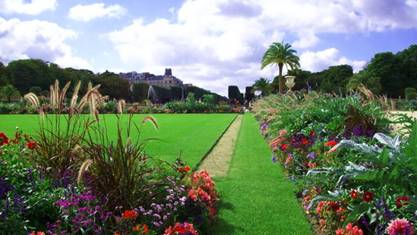
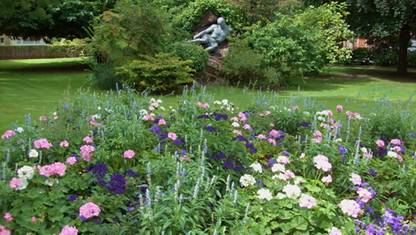
from our chairs in the Luxembourg Gardens.
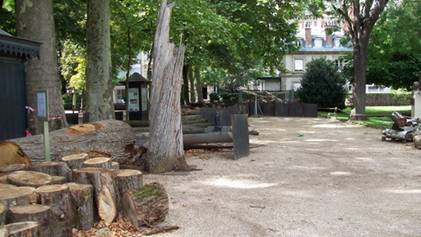
Every
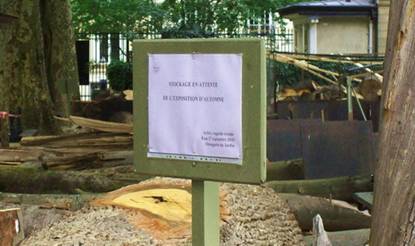
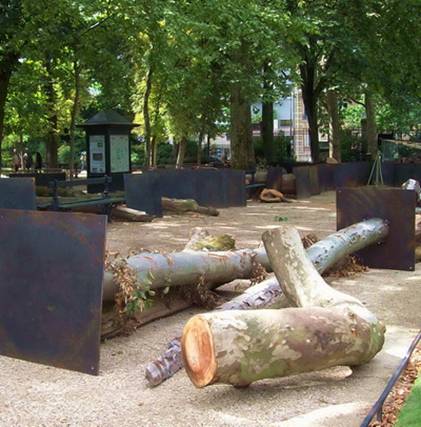
year, there are strange temporary modern art exhibits in the Luxembourg
gardens. The one waiting to be installed
here involves storm-damaged tree trunks.
The taller ones are affixed to heavy square metal plates on the
bottom. It will be interesting to see
how this evolves.
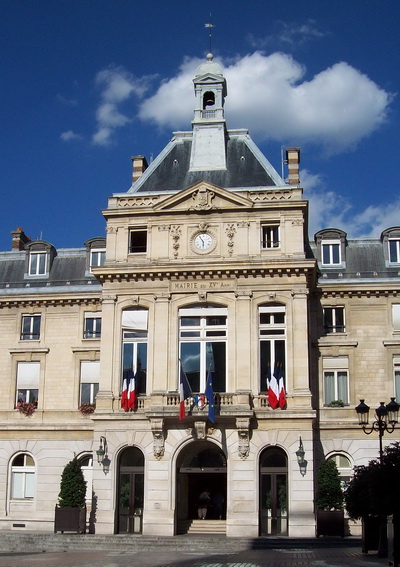
The
mairie, or town hall, of the 15th
arrondissement. A stately building,
indeed.
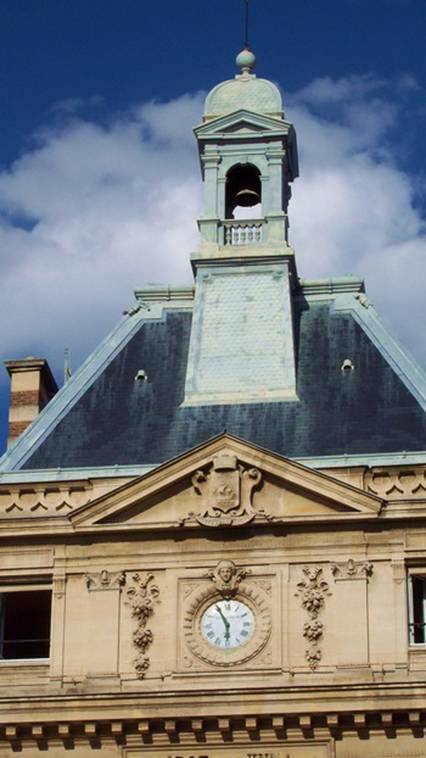
Clock
on the central tower of the town hall for the 15th arrondissement.
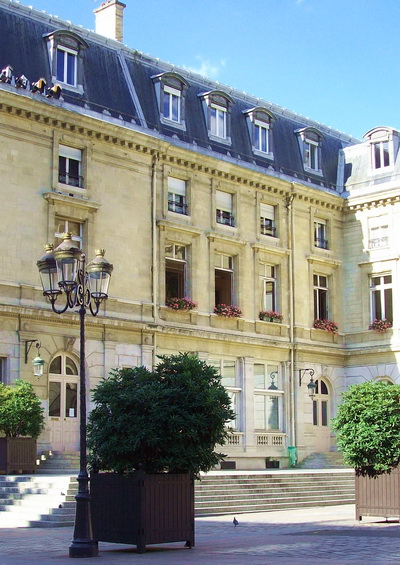
Another
part of the 15th arrondissement’s town hall. |