Paris Journal 2010 – Barbara Joy Cooley Home: barbarajoycooley.com
Photos
and thoughts about Paris
Sign
my guestbook. View
my guestbook. 2009 Paris Journal ← Previous Next
→ ← Go
back to the beginning
|
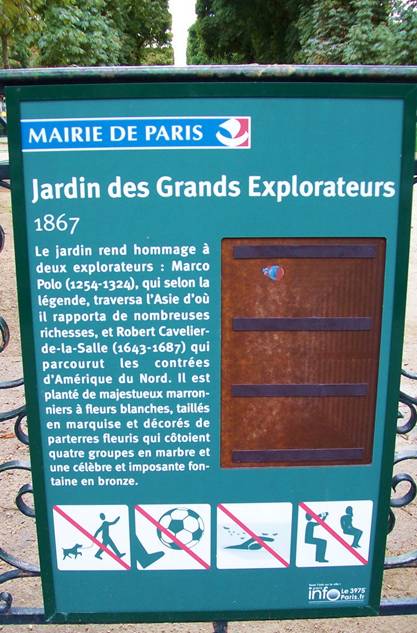
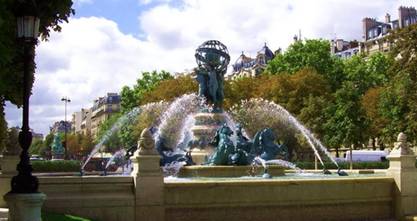
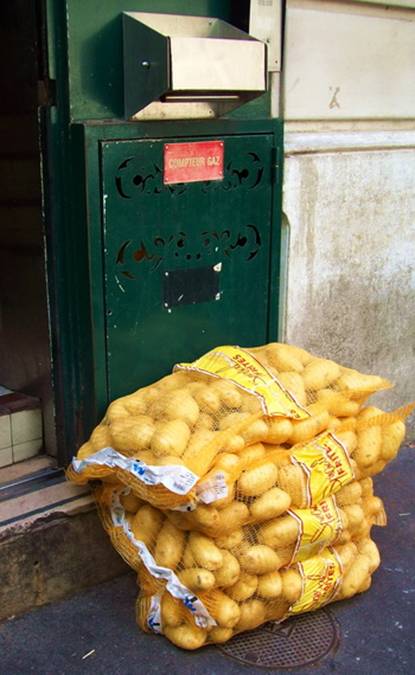
On Sunday, we completed our move and then started walking toward our friends Carol and Ron, who were out for a walk in the vicinity of Odéon, the national theatre. They went into the Bouillon Racine at 2:30PM and found that the kitchen would be closing at 3PM. So they used their British cell phone to call our French cell phone (isn’t this wonderful?) and we were already one-third of the way there. We assured them that we’d be there in five minutes. I don’t know who is in the kitchen now at Bouillon Racine, but whoever it is, they are creative, mixing modern and traditional cuisine. The two best examples were my main course, and Carol’s dessert. My lunch was a Piperade d’Encornets. Encornets are round circles of squid. A piperade is a Basque dish made with a pepper-based cream sauce. This particular piperade had a rich, orange sauce laced with vegetables, including bits of roasted peppers, and it hosted a plethora of soft, delicate-tasting squid circles and slices of a Spanish or Provençale saucisson. It was absolutely delicious, and not so traditional French. It really was more Spanish than French. When it was time to order dessert, unfortunately we were given the English menus instead of the French. Carol and I puzzled over what was meant by “Pressed mangos with gingerbread,” and she thought that perhaps they would be dried mangos. That sounded very un-French to me, so I thought it was perhaps a problem of translation. I asked politely for one menu in French. When the server brought it, Carol and I (both French speakers) opened it, found the same dessert, and then shared a hearty laugh. The French was “Pressé de mangues au pain d'épices.” It really is a dessert made with real mangos pressed into a terrine with a core of gingerbread running through the middle. It is served as a slice of terrine, with delicious mangoes and a center of gingerbread. Restaurants in South Florida should make this because mangos are grown there. It is a wonderful, tropical dessert. Very tasty. We all came back to the apartment in the 6th after lunch, each consuming a glass of wine (except Tom), and then Carol and Ron were off to catch the Eurostar. I later received an email from Ron, informing us that it was only a five-hour trip for them, door to door. They are so fortunate to live so near Paris. I hope they come back to the apartment here often. In the evening, having had such a big lunch, Tom and I stayed in to nibble on cheese and Paris ham, and to unpack and get ourselves organized. When I woke up in the wee hours of Monday morning, I had a bit of a scratchy place in my throat, and one swollen gland: the almost sure signs of an oncoming cold. I had one remaining Zicam tablet from last year (actually, the CVS generic form of Zicam). I took it, and went back to bed. I stayed in bed as late as I could force myself to do so, and then Tom and I went out for a walk through the Luxembourg Gardens. The day was lovely, but a bit cool. I was really bundled up, with far more layers of clothing than I’m accustomed to wearing. We circled around the main gardens a couple times, and then went on down through what I and several maps have been calling the Marco Polo gardens, but I now see from a sign on one of the fences that it is called the Jardin des Grands Explorateurs, of whom Marco Polo is one. I think the lower part is his garden, and the upper part is the garden for Robert Cavelier de la Salle. That’s right, the La Salle who explored America in the 17th century. We stopped to admire the glorious Fountain of the Four Corners of the Earth (Fontaine des Quatre Parties du Monde), which some say is the most beautiful fountain in Paris. We then went over to the monument to Tarnier, a man who dedicated himself to improving the lot of women and children. Here’s an interesting description about this area of the Jardin des Grands Explorateurs and its history. We turned toward the boulevard Montparnasse, and before we got there, on the sidewalk by the side/delivery entrance to La Closerie des Lilas restaurant was a beautiful stack of raw, large golden potatoes, labeled “FRITES.” These large potatoes are used to make frites (French fries) because the French like long frites. A man from the restaurant popped into the doorway. A large black woman came along the sidewalk and asked him, in French, if he was of the neighborhood. He vigorously shook his head “no” and disappeared inside. I thought that was rather rude. She asked us if we were of the neighorbood, and we answered “non,” but as she turned to walk away, I asked her “Avez vous une question?” I knew that she probably needed directions, and we were equipped to help her. She was pleased. She asked if we knew where the rue Fustel de Coulange was. I asked Tom for the Paris Pratique book of maps by arrondissement that we carry around with us, to help us in our explorations. It truly is the “indispensable,” as it says right on its cover. I looked up the tiny street, found it on the map, and explained to her how to get there. It is a small street near the imposing and impressive Val de Grace military hospital, not far from where we were all standing. She happily took off for the rue Fustel de Coulange, thanking us. Tom wished her “bon chance” (good luck). I think we left her with a very good impression of Americans. This street, by the way, is named for Numa Denis Fustel de Coulanges (1830-1889), historian and directer of the école normale near this location. I like cities that name streets after historians. We went on around the corner, pausing briefly to consider eating lunch at the brasserie part of La Closerie de Lilas, but I really wanted to see if L’Abri Côtier was open. I thought their fish soup on a chilly day would be just the right thing to consume. So we went on down the boulevard, and fairly soon I spotted a pharmacy – the site of our next adventure. I needed some more Zicam, or something like it. I’d brought the little empty CVS generic bottle with me, along with a piece of paper with the name “Zicam” written on it. We know the routine in these pharmacies. There is no self service. You wait in line to speak to the pharmacist, and then you ask his/her advice about your medical need. The place was especially small, but there were three pharmacists behind the counter! All very professional looking! An older couple was just finishing up their business at the counter. Almost immediately, all three pharmacists were saying bonjour and asking if they could help us. One was a short brunette lady with glasses. One was an older guy with very short gray hair. I chose the one in the middle, a 50-something moderately tall blonde with German bone structure. Hey, we all identify with people who look like us. I said bonjour, and please madame, I am looking for something like this, giving her the little empty CVS bottle, which she immediately turned over to read the active ingredients. I explained (all in French) that it was a homeopathic medicine for colds, and showed her the name “Zicam” on the piece of paper, explaining that it was another name for the substance. The pharmacists chuckled a little bit at the name. Later I checked to see if “Zicam” has meaning in French, but it doesn’t. They just thought it was a clever name for a medicine that uses zinc to inhibit the cold virus from binding to the ICAM-1 receptor on human cells. Bien sur! The pharmacist, after some examination of the bottle and a list that she had, said no, they did not have anything like that. She was just going to let it go at that, I could tell from her body language. She would have let us walk out the door, except that I smiled a little, nodded and said, “Pas en France,” agreeing that they don’t have such a thing to offer in France. I think all three pharmacists were then on their feet. I’d said the magic words. But of course, France would have something! The pharmacist of my type said, “Quelque chose homeopathique? Pour rhinites?” And I said “oui.” She briefly consulted her list, and went to get a box of Coryzalia off the shelf. These are tiny lozenges that dissolve in the mouth, like the larger Zicam tablets do. But the homeopathic ingredients are completely different. These were homeopathic ingredients in a very old-fashioned sense of the word. Those who know their Latin names of old-fashioned perennial flowers will recognize some of these: Allium cepa, Belladonna, Sabadilla, Kalium bichromicum, Glesemium, and Pulsatilla. The old-fashioned homeopathy employs a philosophy/technique that is something akin to the saying “a hair of the dog that bit you.” A tiny, tiny little bit of a number of things that could kill you if you consumed enough. I was already feeling much better, with the one Zicam and my immune system already working on obliterating the cold before it could really take hold. But the lozenges were only 6 euros, so we bought the box and I proceeded to take a few over the next several hours, following the instructions. By late afternoon, I was good as new. In the meantime, after paying for the Coryzalia and thanking the pharmacist for her assistance and her patience, we went on down the boulevard, looking for lunch. Unfortunately, L’Abri Côtier is still closed for vacation until tomorrow. So we went on to Chez Fernand, where we’ve dined once before, and examined the special lunch menu they’d posted out on the sidewalk. It looked good, and was certainly a good value: 16.50 euros for two courses and a glass of wine. I ordered one of the special starters of the day, a mixed green salad with skate and capers (capers being high in Vitamin C), finished with a vinaigrette. Delicious. Tom skipped the starter so he could have dessert later – an excellent blueberry tart. I ordered the Basque chicken with risotto, which was very good, although my risotto is much better. Tom had poached salmon with tagliatelle pasta in a light olive-oil and herb sauce. Very nice. So for two days in a row, we had our main meal at mid-day. In the late afternoon, after resting a bit in the apartment, we walked over to La Grande Épicerie at Bon Marché. There we bought a thick slice of good Terrine Provençale to nibble on in the evening, and some Salers cheese (but this cheese was not as good as that of the fromagerie in the Saint Germain market, which hopefully will re-open today). While selecting the terrine at the butcher/deli counter, I noticed some sausages that looked almost exactly like the weiswurst that we had in Munich at the Weisse Brauhaus with Arnold and Mareen. I asked if these sausages, which were vaguely labeled saucisse gourmand, were made from veal? The salesperson didn’t know, she said she thought perhaps pork, but she asked her supervisor. These were indeed made from veal, so I bought two to simmer for breakfast today. Then I had to find the right mustard to go with the veal sausages – the kind with all those round grainy mustard seeds through it, but also made with some sugar or honey in it. There were so many kinds of mustard to look through. This task took me at least 15 minutes. The French consume more mustard per capita than any other nationality, according to Mareen. In fact, a jar of mustard was brought to our table at Chez Fernand where I had a Basque chicken that already had a nice sauce, and Tom was eating poached salmon. Mustard on salmon? You must be crazy to do that. After buying these and a several other things at the busy Grande Épicerie, we walked home. We tried the mustard with the terrine, and it was very good, but I found that I’d have to add more honey to it for it to be right with the sausages today. So we just had a fine, late breakfast of one simmered veal sausage and one egg each, cooked sunny side up in French butter. Lovely. The sausages were not quite the same as the ones in Germany, but they were very, very good. Tom says he even likes them better. The German weisswurst had a very smooth texture, and the French veal sausages have a slightly coarser texture inside, and a bit more variety in taste. Now we’re getting closer to our normal routine. Life is good. Sign
my guestbook. View
my guestbook. Note: For addresses & phone numbers of restaurants
in this journal, click here. |
Tuesday, August 31, 2010
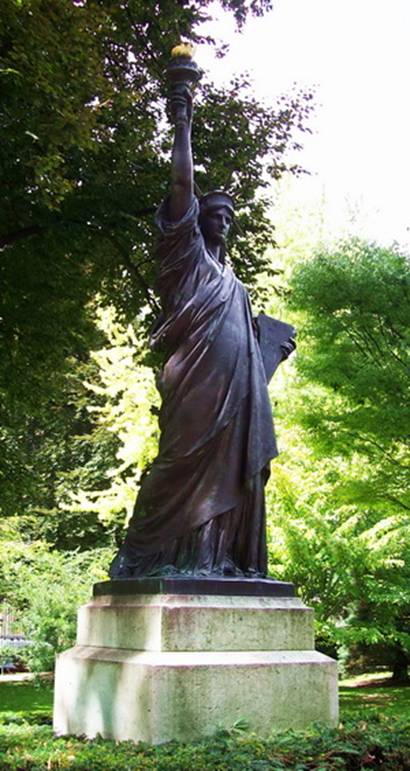
Small
statue of liberty in the Luxembourg Gardens.
Something
has been removed from this sign for the Jardin
des Grands Explorateurs.
Fontaine des Quatre Parties du Monde.
Big,
beautiful potatoes waiting to become fries at La Closerie des Lilas on the
rue Notre Dame des Champs and the boulevard Montparnasse. Note the old fashioned gas meter box behind
the potatoes.
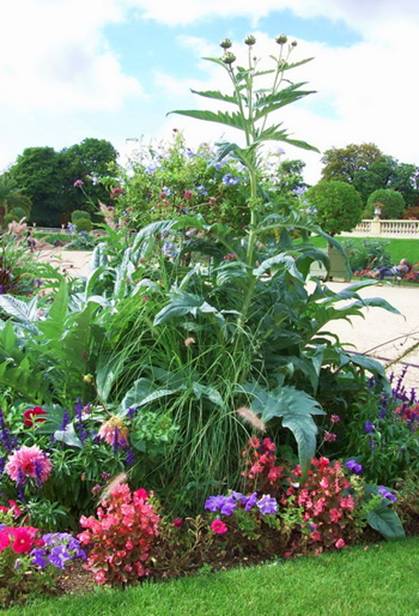
Plumbago,
trimmed or grafted to take a small tree form, and a big thistle grace most
corners of the big central flowerbeds of the Luxembourg Gardens.
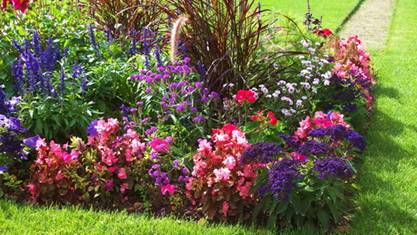
More
beautiful Luxembourg Gardens flowers.
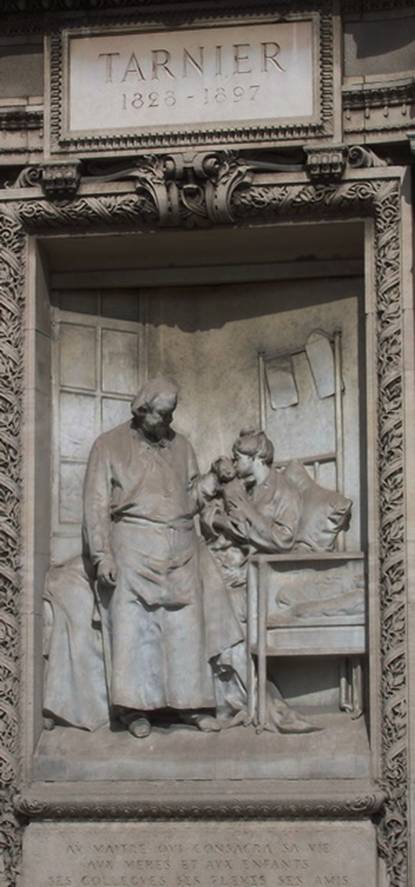
Tarnier,
a “master who consecrated his life to mothers and children, his colleagues,
his students, his friends.” |