Paris Journal 2010 – Barbara Joy Cooley Home: barbarajoycooley.com
Photos
and thoughts about Paris
Sign
my guestbook. View
my guestbook. ← Previous Next
→ ← Go
back to the beginning
|
We had just exited a shop called Aristoloch, where I’d purchased two pairs of earrings, and we saw a real Aristocrat: Dominique de Villepin. Yes, I mean we were right there on the sidewalk on the rue Saint Sulpice, and there he was. He’s very tall. You can’t miss him. He greeted several passers-by, but he missed us. The last passer-by he talked to was a small boy, who was with his grandmother. The grandmother was positively beaming about this wonderful opportunity for her grandson to meet a great man. And for us, too, it was a treat to be right there, smiling and witnessing this sweet encounter. I was close enough to have reached out and touched de Villepin’s sleeve, but of course I didn’t do that. After talking with the little boy, Monsieur de Villepin, along with a friend and a bodyguard, disappeared into a bookshop down the street. We’d just been looking into that bookshop’s window about 20 minutes earlier. We went by the bookshop again. Looking inside, we only saw the shopkeeper and the bodyguard. Dominique de Villepin and his friend must have gone upstairs. Not everyone loves Dominique de Villepin. President Sarkozy has a problem with him, for example, because Sarko believes de Villepin was part of a character assassination plot against him a few years ago. Everyone here seems to think of de Villepin as an aristocrat, but Wikipedia claims that he came from a “middle class” background, born in Morocco, and raised in Latin America. Ahem. Wiki then goes on to say his great-grandfather was a colonel, and grandfather was on the boards of several companies. His dad was a member of the Senate. Excuse me, but that is not a typical “middle class” background. Furthermore, Dominique de Villepin studied at the very elite “Science Po,” the Institut d’Etudes Politique de Paris, as well as the very elite ENA, or École Nationale d’Administration. That makes him what is known as an “énarque,” because he graduated from this prestigious school started by Charles de Gaulle. Almost all énarques are powerful people. There have been many things written about de Villepin in the news media, but lately, I just don’t know what to think of the news media, especially in France. I’m sorry, I love France, I love the French people, and I certainly love French food, but there are some things I just cannot reconcile. First, the news media sugar-coat France’s history. In a little article about the upcoming sale by Sotheby’s of an original Birds of America book by John James Audubon, Le Parisien really laid it on thick. The reporters at Le Parisien proudly point out that John James was not his real name, but rather it was “Jean-Jacques,” which is sort-of true. They also proudly point out that he was born in 1785 in Haiti, which was then a French colony, of French parents. And then, he became a naturalized American citizen. Whoa. Wait a minute here. French parents? Let’s tell the whole story, shall we? John James’s father was a privateer (and a French naval officer) who, like other pirates living in the Caribbean, became an owner of a sugar plantation, and thus, the owner of slaves. John James’ mother was a French chambermaid – the mistress of his father. That’s right, JJ was illegitimate. JJ’s dad also fathered illegitimate children by his mulatto housekeeper. And JJ’s true name was originally Jean Rabin, after his chambermaid mother, Jeanne Rabin. A much-needed slave rebellion occurred in 1788 in Haiti. The French form of slavery in Haiti was particularly brutal and cruel. The French plantation owners amortized their slaves, working them to death rather than letting them have children, because it was less expensive to replace them with newly imported slaves. By far, most slaves only lived 4 to 7 years in Haiti, then known as Saint Domingue. Cold, calculating, wicked economics. So fine. The rebellion convinced JJ’s dad to pack up and go back to France, where he raised JJ and his half-sister. JJ’s dad and stepmother then renamed Jean Rabin as Jean-Jacques Fougère Audubon. At last he had his father’s last name. France, and the way he was treated as an illegitimate son, did not suit JJ at all. At the earliest opportunity, when he was 18 – in spite of the fact that he knew he was prone to seasickness -- he boarded a ship to immigrate to America, where he changed his name to the Anglo-Saxon John James Audubon. In the Luxembourg Gardens earlier this month, we encountered an exhibition of panels about the history of slavery. Talk about sugar-coating! Oh la la! Nowhere did the panels explain or apologize for the particularly cruel practices of plantation owners in French colonies like Haiti, and nowhere did the panels admit to the fact that the French imposed a crippling debt on Haiti. After its independence (1804), France imposed an embargo on Haiti. In 1825, it demanded (blackmail) that, to have the embargo lifted, Haiti had to pay the equivalent of $21 billion (today’s dollars; 150 million francs in 1825), as “compensation” for their loss of property. That property was not just real estate, but the bodies of the Haitian people themselves. Property, indeed! Haitians are the only former slaves who had to pay the imperialists for their own bodies. That debt destroyed Haiti’s future, and led to many or most of its subsequent difficulties in forming a functional government. The exhibit in the Gardens attempts to portray France as no different from other European countries with slavery-based colonies. The responsibles for the sugar-coated exhibit in the Luxembourg Gardens are the Comité pour la memoire et l’Histoire de l’Esclavage, www.cpmhe.fr . The exhibition was created under the direction of Françoise Vergès. And now, we come to the front-page headline in Friday’s edition of the Metro Paris free newspaper. It was USA: la fievre anti-islam, or “USA: the Anti-Islamic Fever.” As Tom pointed out, if an imam at a tiny extremist mosque in some city in Afghanistan wanted to burn a pile of Holy Bibles, as Americans we would probably say, “Okay. Go right ahead. But be careful now, don’t burn yourself.” And the news media would pay no attention to it whatsoever. Hey, it may happen on a weekly basis, for all we know. Surely lots of Holy Bibles have been destroyed by extremists. I haven’t heard of any churchgoers in Indiana threatening violence because Holy Bibles have been burned in some part of the world. President Obama is right: That Terry Jones was attempting a publicity stunt. “Stunt” was exactly the right word to use. And the news media, dopes that they are, played right into Jones’s hands. How this nut-case who leads a church with only 50 members (although his city, Gainesville, is not so small), gets so much attention is mind-boggling. And the French news media are being duped as much or more than any other media. To write such a misleading headline is just plain wrong, and I think they know better. And it seems ironic, to have Western Europeans lecturing on the subject of religious tolerance, given their history. So many Americans’ ancestors emigrated from Western Europe to escape religious persecution. And then there was the Holocaust. My friend Arnold, from Germany, says that even today, in Bavaria (southern Germany), if you are not Catholic, you have no chance at the best jobs. Being Protestant doesn’t cut it. I’m sure being Muslim would lessen your chances even more. I read the crime news in the French papers. There are many incidents of racially based attacks in France. Yet the papers don’t have headlines about “France: the anti-Islam Fever,” or France: the anti-Semitic Fever.” They don’t, because it would not be fair. The vast majority in France want deeply to eliminate racism and religious persecution, as do the vast majority in America. Note that it is in France where the burqa might be banned; I sincerely doubt that will happen in the U.S. While anti-Americanism must be alive and well, given this kind of news headline, we as individuals are treated very well here. People are as nice as can be. For dinner last night, we went to Le Tournon, a brasserie which is near the Senate but which is a regular, not fancy, brasserie. We were a bit late; all the other customers (all French speakers) of the evening were already there. Still, we were greeted warmly and given a nice table. We both had the leg of lamb special of the day. It was just about as good as it gets. It came with sautéed potatoes and a very nice, fresh mixed-green salad with a light dose of vinaigrette. We shared the tart of the day, a sablé aux figues. It tasted like a warm fig newton on steroids. It was very, very good. Le Tournon does not cater to tourists at all. There is no English menu; not even an abbreviated one. I’m sure they do not want tourists. Yet we went there, speaking French with an American accent, and we were treated well. The restaurant offers wine by the glass, at very reasonable prices, and the choices are many. It is a calm place, which was welcome after our afternoon of wandering through streets of the middle part of the 6th, that were just alive with throngs and throngs of people. Even the Luxembourg Gardens was loaded with more people than we’ve ever seen there before. Why? Because it was a beautiful Autumn Saturday afternoon. Tout le monde was out and about. A funny thing happened yesterday afternoon. We showed up for the concert scheduled for 4PM at the gazebo in the Luxembourg Gardens. So did many other people. The musician, Pierre Souchon, never showed up. He was supposed to be performing the proverbial French songs. Nobody from the City of Paris came by to offer any explanation, either. We all just sat there in our chairs, chatting and people-watching. At 4:30, the time that the concert was to be ending, Tom and I left. I think we were among the first to depart. Almost everyone else just kept sitting there, waiting, while nothing happened. Occasionally, someone would get up, go over, and check the posting of the concert schedule, assuring themselves that yes, the concert was supposed to be going on. This morning, I checked Pierre Souchon’s web site, and saw that concert is listed as “cancelled.” So why didn’t anyone come to tell us that yesterday? C’est la vie a Paris. Sign
my guestbook. View
my guestbook. Note: For addresses & phone numbers of
restaurants in this journal, click
here. And here’s the 2009 Paris Journal. |
Sunday, September 12, 2010
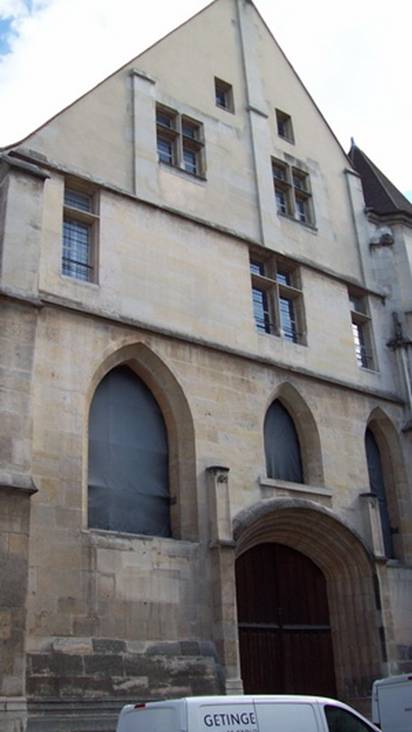
Medieval
refectory at the former Cordeliers convent.
Now, it is used by the city of Paris for exhibitions, and we think it
is being restored. Surrounding it are
surgical college buildings.
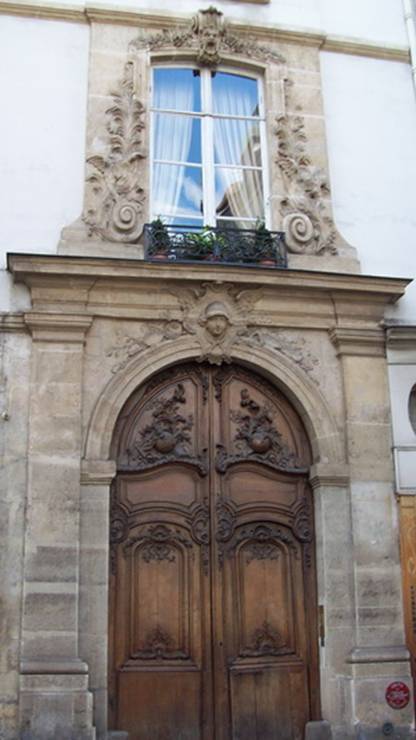
Handsome
door on rue Monsieur le Prince, across from the rue Antoine Dubois.
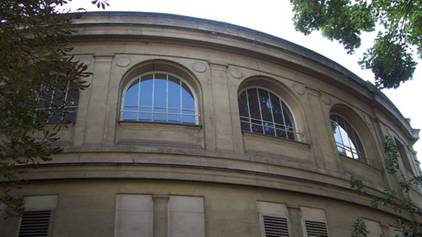
The
ampitheatre at the surgical college on the grounds of the former Cordeliers
convent. Big arched windows provide
lots of natural light for performing surgery before rows and rows of
students.
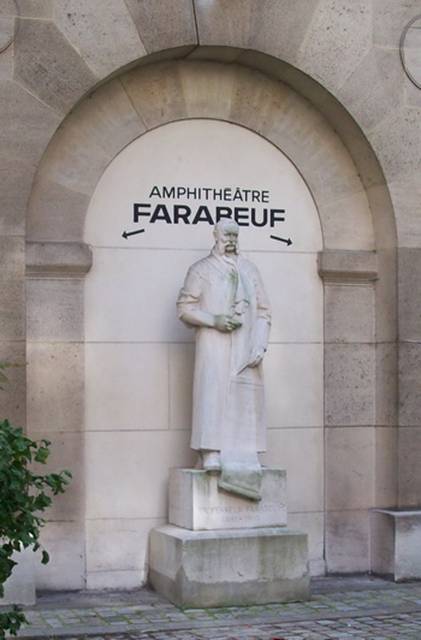
Dr. Louis Hubert Farabeuf
(1841 – 1910), the surgeon for whom the ampitheatre is named, supposedly
introduced hygiene to French medical schools.
Above
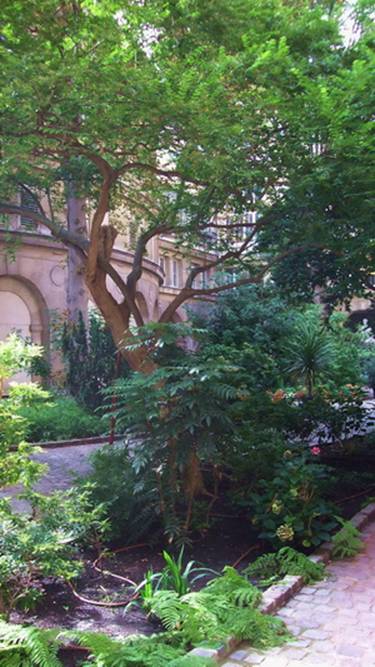
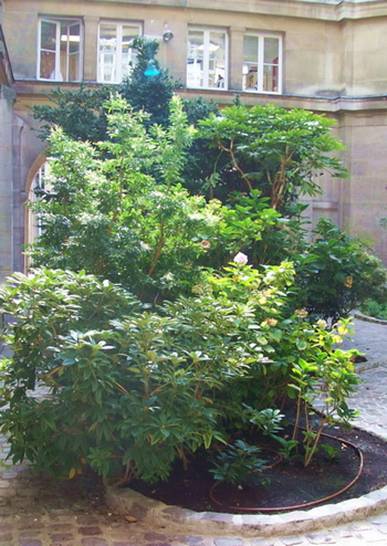
and below, the garden in the surgical college on the grounds of the former
Cordeliers convent. I’m guessing that
this is where the cloisters were.
|