Paris Journal 2009 – Barbara Joy Cooley Home: barbarajoycooley.com
Sign
my guestbook. View
my guestbook. ← Previous Next
→ Back to the beginning
|
The web site for Journées du Patrimoine had the
hours wrong for the open house at the mairie
(town hall) for the 6th arrondissement. So we’d tried to visit it on Saturday, only
to be turned away by a very unfriendly man who must be some sort of guardien
– wearing a navy sweater rather than a security guard uniform. He barked at us that the visit was at 3PM. Of course, at
3PM we were over in the 7th arrondissement, soaking up the
sumptuous sights in stately homes and gardens. So yesterday
was our day to visit the mairie. We thought there would not be much to it,
and that we’d have plenty of time to visit the Lycée Henri IV afterwards. We arrived a
few minutes before 3PM, and one other person was waiting with us – a
middle-aged French woman. While we
waited, we sincerely hoped that the unfriendly guardien and his colleague, an
equally scowling guardienne, would not turn out to be the guides. Another man showed up briefly, looking more
like a security guard and looking like the boss of the scowling ones. He seemed a bit friendlier, so we hoped
he’d be our guide. But then, about
two minutes before three, a bubbly little round Frenchman with nice brown
eyes and a warm smile approached us.
He would be one of our guides, he said, but the main guide would be a
woman – his boss, I think. She arrived
promptly at 3, and took us (there were perhaps four or five of us by then)
across the street so we could get a good, full look at the exterior of the
building. She was super friendly, with
a nice big smile and welcoming demeanor. She had a
script that someone had prepared for her, and it was several pages long. She felt the need to speak rapidly to get
through the script. She didn’t want us
to miss anything. Because of the speed
of her speech, Tom and I missed a lot! After she
explained the somber façade, we went into the entryway where she pointed out
the door to the Tribunal d’instance
(small claims court) and a marble statue sculpted by Fournier, representing
the still-life painter Chardin
who once had his studio in the neighborhood. Across the
entry is a monument to to those who died for France. In between is a passageway into the
courtyard, and to the right is a grand staircase called the escalier d’honneur leading to the
reception hall that is used mainly for official ceremonies and weddings. It also leads to the mayor’s office. On a landing of
the staircase is a lovely sculpture called “Carolina” by Marcello
Tommasi. At the top of the stairs is a
large painting called “Homage to Work” by Henri Martin
– romanticizing the labor of those who enlarged the Palais du Justice in 1914. The reception
hall called the salle des mariages
has a fantastic view of the fountain in the middle of the Place Saint
Sulpice. It has the feel of a somber
oak courtroom, and is furnished with a couple hundred comfy chairs covered in
blue velvet. At this point in the
tour, there were about 15 of us in the group. Off of each end
of the hall is a smaller room with interesting paintings of nearby places
like the Place Saint-Germain des Pres and the Saint Sulpice church. Next we visited
the mayor’s office, and admired the nice view of the Place Saint Sulpice as
well as some nice paintings and a couple strange little round chairs. We left that
front section of the mairie by
taking a corridor down the side to the back wing, where the salle de fetes is located. I’d call this the ballroom, because that’s
what it looks like. The ceiling is
ornate and has three great, round paintings – representing liberty,
fraternity, and equality – put in place in 1890. These are the work of Emile
Levy, a former student of Fromentin and Cabanel, who also worked on the Paris
city hall and the Panthéon. The whole room
is richly decorated, unlike the somber salle
de mariages. I’d rather host a
wedding in the salle de fetes, but
the acoustics are perhaps too cavernous. Off of one end
of the ballroom was a room with an enormous mirror and a ceiling painted by Louis-Edouard
Fournier in 1890. He is known for
a huge mosaic he created at the Grand Palais. A second escalier d’honneur led us towards the
courtyard. Along the staircase are
huge plaques engraved with the names of those from the arrondissement who
died in the wars of the twentieth century. Looking at the
building from the courtyard, you have the impression that it was all built at
pretty much the same time. Not
so. The front façade and the two wings
on each side were built first (1847-49), then the last part which joins the
two wings was built in 1886, providing the great ballroom. In the middle
of the courtyard is a magnificent statue that we’ve seen from a distance
whenever the big gates to the mairie
are open. It is perhaps the one thing
that prompted us to take the tour – so we could get a closer look. It is called
the Combat de Centaure, sculpted in
Carrera marble by Gustave Adolphe Grauk (1827-1920). He received the grand prize in Rome for
this work. It was shown at the Grand
Palais during the 1900 World’s Fair.
After the fair, it was installed at the mairie. The mairie of the 6th was the
first to be constructed as a mairie. Prior to that, mairies had been situated in stately homes that were converted to
mairies. At the end of
the tour, the friendly little round Frenchman gave us each a brochure that
summarized the tour. This is smart –
don’t give the students something that will distract them from what you are
saying. Give them the brochure AFTER
the lecture. We thanked our
guides and made our way back out onto the street. While it was true that we struggled to
understand the rapid lecture, we were pleased with the impression that nobody
seemed to notice that we weren’t French.
Since we were listening intently, and not saying much at all, we just
seemed like other rapt students in the class. Even though I
was straining to understand, I kept a pleasant, relaxed look on my face – I’m
sensitive to the fact that visual feedback is important to speakers. I didn’t want her to see my struggle at
all. I was rewarded with lots of eye
contact from the guide -- while the
others were looking off at this or that, I looked at her more often so she
looked at me. She had no clue that I
only understood a third of what she said in her rapidfire French. After an hour
of intense concentration, and after Saturday’s touring binge, we had no
desire to go on to the Lycée Henri IV.
It seems to be open every year on Patrimony Days, so we’ll save that
one for next year. We went home,
rested, and then went to John and Linda’s apartment on rue du Cherche Midi,
where we were also joined by Ray and Jana.
After a drink, the six of us walked up to the rue de Grenelle to have
a fine dinner at La Petite Chaise where I’d made a reservation at 8. Everyone was pleased with the food, and our
conversation was quite lively all evening. We saw Ray and
Jana off – they took a taxi back to the utterly charming Hotel des Grandes Ecoles on
rue Cardinal Lemoine. Then the four of
us remaining walked to the place where the rue du Cherche Midi and the rue
Vieux Columbier begin. There we said
good night and went our separate ways.
What a day. Sign
my guestbook. View
my guestbook. |
Monday, September 21, 2009
Statue
outside the reptile house at the menagerie in the Jardin des Plantes.
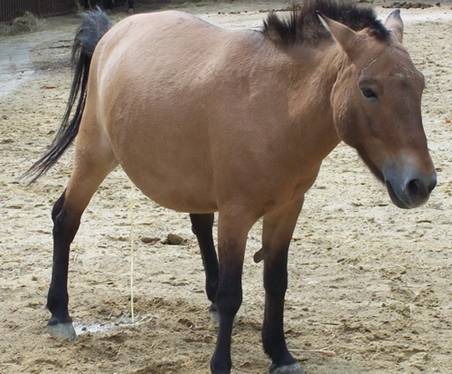
Wild
horse in the menagerie.
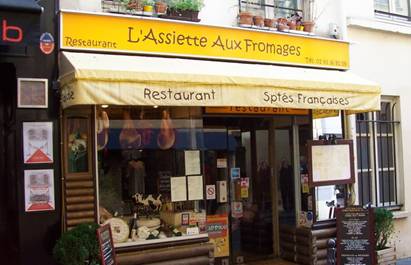
A
restaurant and fromagerie on the rue Mouffetard.
The
St. Médard church at the bottom of rue
Mouffetard. |