Paris Journal 2009 – Barbara Joy Cooley Home: barbarajoycooley.com
Sign
my guestbook. View
my guestbook. ← Previous Next
→ Back to the beginning
|
At three of the
four stately homes we visited yesterday, we were given a black-and-white,
simple page or flyer describing the house and its history. Also at the Protestant church, the Reformed
Church of the Pentemont-Luxembourg, we were given a simple black-and-white
flyer. But at the
Hôtel de Castries, we were given a brochure printed on heavy stock in
four-color. We’ve been
seeing all kinds of signs that government agencies have had their budgets
tightened. Even the Senate cut back;
there were no temporary modern art exhibits in the Senate’s Luxembourg
Garden’s this summer. But somehow,
the minister of “L’Espace Rural et de
L’Amenagement du Territoire” and the secretary of state charged with
“Developpement de la Region Capital” haven’t received the memo yet. I’ll call these guys the Development Office
for short. Even though the
brochure is extravagant compared to the others, its extravagance does
indicate a certain pride in the building.
But I wish that pride translated into better care for the building,
especially its elegant windows. The wood on the
windows is rotting. Much of it is
completely exposed to the weather – the paint long gone. It made me sick to see this, because these
aren’t just any windows. They are
especially nice. Last year, we
visited the Hôtel de Clermont (69 rue de Varenne) during Patrimony Days. It is home to the minister for
parliamentary relations. It has an
even more elaborate, more expensive brochure, and I noticed that some people had
them in their hands yesterday. So that
publication is still being distributed. The difference
is that the parliamentary relations minister’s office is taking much better
care of the Hôtel de Clermont than the Development Office guys are doing for
the Hôtel de Castries. By the way, the
Hôtel de Clermont had a long waiting line yesterday. Word has spread about how nice it is. Here’s some
colorful history of the Hôtel de Castries from the four-color brochure: It was Jean
Dufour, lord of Nogent, who had the Hôtel constructed during the end of the
17th century. In 1708,
however, it was sold by his widow to Jean-Francois de la Croix, the Marquis
of Castries and the Baron of Castelnau.
The property remained in the Castries family just up to the end of the
19th century. The
architecture of the home remains that of the Grand Century – a stately
building surrounding a square courtyard.
During the Revolution, the home went through a number of
vicissitudes: it was pillaged,
devastated, and saved only by the arrival of the national guard and by a
harangue by La Fayette, who alone was able to calm the mob. During the
Terror, the Castries family took refuge abroad. The home was seized by the government and
used by the minister of War, who was to be the future mayor of Paris,
Jean-Nicolas Pache, who was none other than the son of the former concierge
for the Castries family, and the répétiteur
(coach or tutor) of the young count Charles Eugène! The story was that the young count
continued, in spite of his title, to take his meals in his former home. The first Duke
of Castries, Count of Charlus, Armand-Charles, married Marie-Louise Philippe
de Bonnières de Guines de Souastres, to whom Mozart had given harp
lessons. With her, Armand-Charles had
one son. When he became widowed, in
1795, he married an Englishwoman, Elisa Coghlan, who gave him a second son,
named Armand-Charles Henri.. The Castries
family came back to Paris during the Restoration. The eldest son, Edmond-Eugène Philippe, had
married Claire-Clemence Henrette-Claudine de Maillé in 1816. The marriage was a failure, and the Duchess
of Castries had an affair with Victor de Metternich, the fragile son of the
Austrian chancellor, and then, after his death, had a platonic relationship
with Balzac. With Metternich, by the
way, she had a son. In 1833,
rivalries between the two half-brothers, Edmond-Eugène Philippe and
Armand-Charles Henri, resulted in a splitting of the estate. The eldest inherited the building, and the
younger got the most part of a very large garden, where he could build. In 1842,
Edmond-Eugène decided to renovate the home, under the direction of the
architect Frölicher. The work was
finally finished in 1866, giving the home the look it has now. The considerable sum of 200,000 francs had
been spent on it, and the grand salon, in particular, was completely re-done. In 1946, the
home was requisitioned for the services of the minister of agriculture. Subsequently, it has served as offices for
a number of government functions. One of the
rooms, which is now the office of the minister for rural development, has a
Louis XVI desk that was used by General De Gaulle and then by President
Pompidou at the Élysée Palace. The Hotel de
Castries only had one tapestry, as I recall.
But the Hotel d’Avaray (residence of the Dutch ambassador) had
several. Two of them were especially
remarkable. They were from Brussels,
and date back to the 16th century.
One represents a falconry scene, and the other an Austrian hunt. They are very large, and quite
impressive. I wondered about how much
ultraviolet light they are exposed to, because the rooms in this gracious
home are quite bright. But evidently,
the tapestries are holding up well. It
was forbidden to take photos in the home, but I think that was for security reasons,
not because of flashbulbs. Last night, we
worked until 8:30 and then wandered out into the dark streets to find a bite
to eat. We did, at the new Italian
place called the Terrazza, at the St. Germain Market. It was nothing elaborate; just a little
something. |
Sunday, September 20, 2009
Six
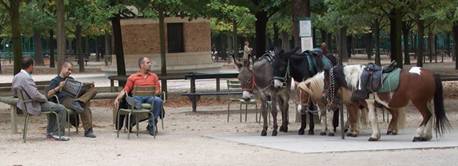
creatures taking a break in the Luxembourg Gardens.
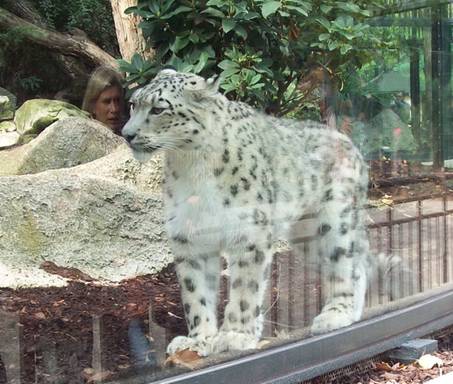
Snow
leopard at the menagerie in the Jardin des Plantes. The woman in the photo is just a
reflection; she is not in the leopard’s enclosure.
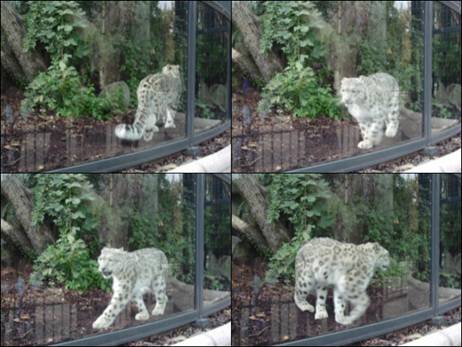
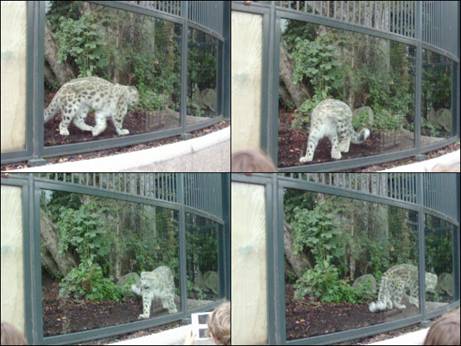
The
snow leopard was agitated and pacing wildly.
Flamingos
dining.
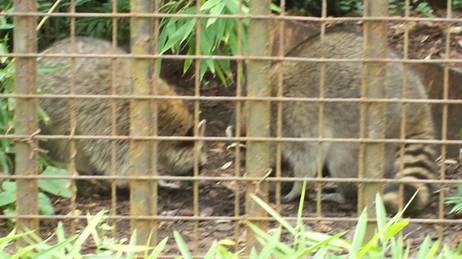
Racoons
are ubiquitous where we live in Florida.
But raccoons do not live in the wild in France – not at all. Called “raton-laveurs” because they wash
their food, they are considered to be exotic animals in France, and so are in
the menagerie. The name for them must come
from French Canadians. Sign
my guestbook. View
my guestbook. |