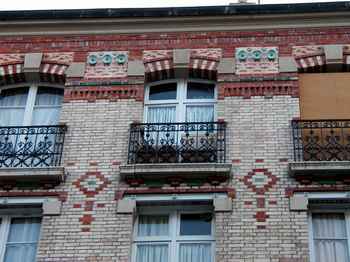
Nearby building with terra cotta blue flowers near the top.
|
This
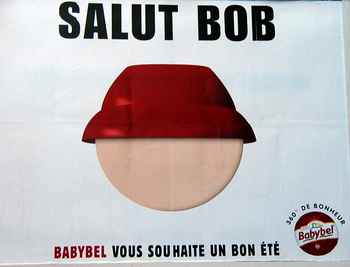
picture is for our friend Bob, in Sanibel. It is a billboard. In Paris,
billboards are generally not so big as they are in the U.S., and they are much more
tasteful. They are also, on the whole, much more high tech. Paris billboards
tend to be placed lower, usually right on the side of a building where there are no
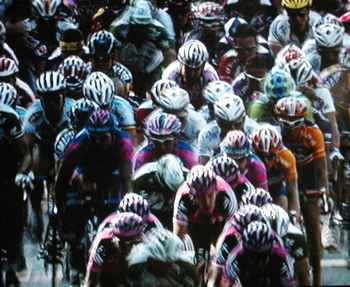
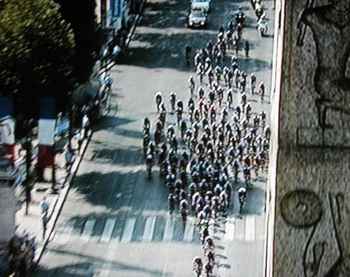
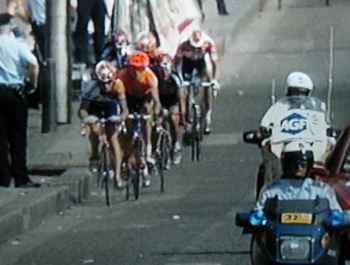
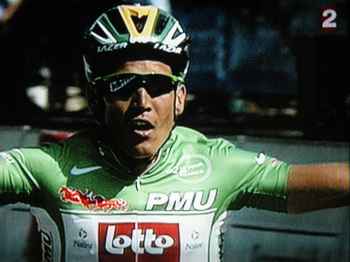
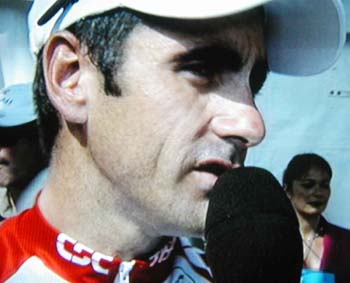
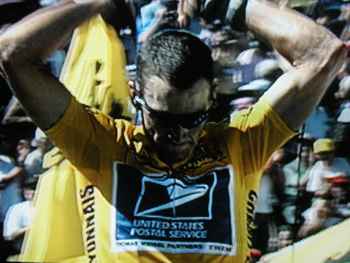
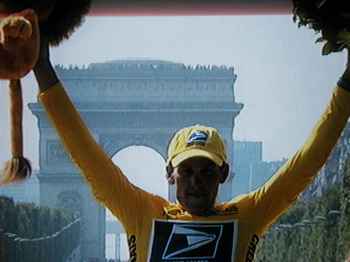
windows. They are oriented as much to pedestrians as they are to cars. This one is selling a popular cheese, and its makers are wishing us a good summer. Besides the name, the hat made me think of Bob's beach hat. Tour de LanceSo, Lance Armstrong won the Tour de France for the fourth time. A year or two ago, we went to the Champs Élysées to watch the tour. Big mistake. As always, we were stuck behind tall German tourists and we couldn't see very well. It was hot. The commentary echoed off the buildings, and so we couldn't understand it. This year, we watched the Tour on TV. This is definitely the way to go. The TV cameras in helicopters and mounted on cars give us a great view of the tour, and they provide some great shots of Paris and environs. The commentators talk not just about the tour and the racers, but they also give flowery commentary on the sights and wonders and history of all the towns and countryside. along the route. They become even more dramatic when talking about Paris. So these pictures are taken from the TV. That's why they are a bit flat and fuzzy. Tom wanted me not to tell you this, and to leave you thinking I took these pictures live. But I know you wouldn't believe I could fly. First we have a couple pictures of the "peloton," or group/cluster. The hieroglyphics you see next to one of the peloton pics is a piece of the obelisk in the middle of Place de la Concorde, a busy space that marks one end of the Champs. The Arc de Triomphe marks the other. This word, "peloton," sounds like "platon" when the announcers said it. So, it took us a while to figure it out. Then there is the "tête," the smaller group out in the front. This year, the race was unusually exciting when it reached the Champs Élysées because one of the winning positions, the green jersey, was still being contested. The green jersey ("maillot vert") is given to the racer with the most overall points. An Australian named McEwen successfully defended his possession of the green, but not without a fight. The "tête" includes him and a few others. As it turned out, McEwen also succeeded in winning this final stage of the tour. France's own Jalabert, known fondly as "Jaja" held the red polka dot jersey, for the best climber ("grimpeur"). Jaja is enormously popular in France, and he received much love this time because it was his last Tour de France. And then there's Lance, the victor. The French have warmed up to Lance in recent years. Now, they positively like him. Much of this is due to Lance's efforts. He and his family lived near Nice for a while, and he learned to speak French. Now they live in Spain. It really annoys the French when international athletes address French crowds in English. Lance's French is pretty good, I think, but I wouldn't venture to say it is fluent (as one interviewee said in a New York Times article recently). He does very well -- he understands what is said to him, and he responds quickly enough, using constructions that are suspiciously American/English, but that seem to work in French. His French is very easy for me to understand, so he must not be speaking it perfectly. But he's my role model, when it comes to learning to understand and speak this language. Sometimes he struggles for the right words. Usually this is just when he's put on the spot, and he's speaking about a subject in which he knows he needs to be very careful. For example, after the Tour he received a phone call from President George W. Bush. W called right in the middle of a live interview that Lance was giving on France 2, the main TV station here. I guess that was intentional. So, we see Lance speaking into a cell phone to the President. It is noisy out on the Champs, so Lance has to clutch the phone tightly to his ear, lower his head and hold his finger in his other ear. W does most of the talking. The camera zooms in on Lance's face and we see that he has turned beet red. Finally Lance says a few words, which we cannot hear, and returns the phone to its owner. The reporter from France 2 asks Lance about the call and the President. Here, Lance pauses and chooses his words VERY carefully. He says that it is a great honor to receive a call from the President, from the White House. He says that the President is another Texan, like himself, and that he is very "sportif," that the President is a real sportsman. The President evidently invited Lance to come see him in the White House when he is back in the U.S. Lance said he replied, "Bien sûr!" Lance did not say that he was a Republican, like the President. Bien sûr! Lance is wise. Lance, by the way, is paid more than a million dollars a year by the U.S. Postal Service. W's salary is $400,000 per year. I'm guessing that salary is a taboo subject when Lance and W talk on the phone. It is fun to listen to how the French pronouce our non-French names. Lance is something like "lawnz," and it rhymes with the way they say France. Armstrong is a very unnatural thing for a Frenchman to say. The French don't emphasize the first syllable, as we do. They struggle equally hard to pronounce both syllables. And they know they are not supposed to treat the R's in Armstrong the way they normally treat R's, by hacking them out from deep in the throat, so they must try hard to say that name, very hard. Robbie McEwen comes out something like row-bee mack-you-whun, where the n on the end isn't really pronounced but ends up somewhere up in your sinuses. And again, there is no emphasis placed on any one syllable. All syllables are treated equally, and they are all run right into each other. Égalité, fraternité . . . this often applies to syllables as well as citizens.
|
| Thanks for the
e-mails you all have been sending me. Charles writes to ask how the quest for the
QWERTY keyboard is going. Well, Charles, we haven't had much time for it, but it
isn't going well. I did receive a response from Office Depot in my e-mail.
They said if I cannot get a QWERTY keyboard through Office Depot's French web site, then I
could contact a particular person at Office Depot in the U.S. to see about having one sent
via their export office. This sounds like cheating to me, so I'm not going to break
down and do that yet. I still have a few ideas about how to find one in Paris, I
just haven't had the time since we work during the day when the shops are open. Charles also asked what the other kind of keyboard is, the kind that they use here in France. It is an AZERTY keyboard. The names come from what the six upper left keys spell out. AZERTY just makes more sense to them, I guess. If you type "clavier qwerty" into Google.com, you get a bunch of French web sites that explain what a QWERTY keyboard is. Charles, you might want to try that - it would be a good way to practice your French! And sorry about all the pop up ads. I can't do anything about it, since I'm using free web sites. I'm too cheap to fork out a lot of money every month for web hosting. |
|