|
Thanks
to yesterday's column by William Safire, I now know what I'm doing here. It's called
blogging, a new word somehow contrived from the term "web log."
But I haven't been putting in links to other web sites, and one is supposed to do that
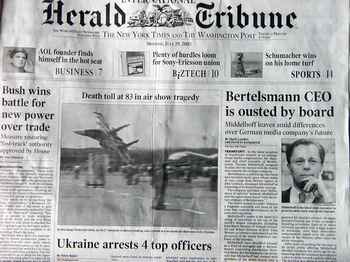
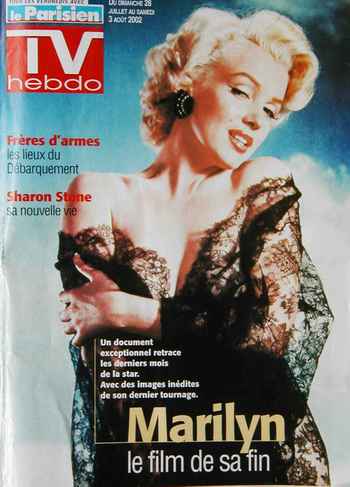
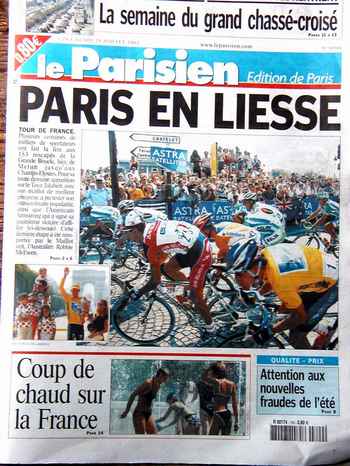
when blogging, it seems. So, I'll attempt to start linking in my text. Safire's column is included in the International Herald Tribune, an English-language newspaper published by the Washington Post and the New York Times and edited here in Paris. It is distributed all over the world, and is aimed mainly at Americans who are overseas. But other people read it, too. I read this paper cover to cover every day. It brings me, among other things, Gary Trudeau's "Doonesbury" comic strip, which lately has had a delicious series featuring an amusing conversation between W and Cheney in the White House. The Tribune has an editorial page that makes me feel good instead of irritated. So I guess it is true that the New York Times and the Washington Post are controlled by liberals. It pleases me that this page may be read by Europeans. I could read it online, but that would be expensive here, where phone connection time is metered and charged for by the minute. And there is nothing like the feel of a real newspaper. When not in Paris, I do read the Tribune online, but it isn't the same. Somehow, when I'm here, I'm more interested in what's happening all over the globe. It is a top-notch newspaper, unlike Le Parisien, the French paper we read here. Bien sûr, Paris has much better papers such as Le Monde and Figaro. But we read French at about an 8th grade level, so we have to buy a dumbed-down paper like Le Parisien. It's American equivalent would be USA Today, but USA Today doesn't have local trashy news. Le Parisien does. Le Parisien keeps us informed about local crime, politics, and other happenings. On Fridays, Le Parisien brings us TV hebdo, the weekly television magazine. Here we can find out when we can watch fascinating shows like "La Carte aux Trésors." In this show, the host is a man in a helicopter who gives each of two actors a envelope containing a map, a challenge and an enigma to solve. The actors compete with each other to see who can meet the challenge, and solve the enigma, first. For each one, they are given only so much time, so they are racing around, followed by a TV camera person. Each actor wears a headset with a wireless microphone, and carries another microphone that they use to interview the hapless people they run into while trying to meet the challenge. Each week, a different region of France is selected as the setting for the La Carte aux Trésors. This past week, it was picturesque Auvergne. In addition to the host's helicopter, each actor has a helicopter, so we get to see lots of scenery, beautiful countryside, from a couple hundred feet above the ground. The actors are given the first envelopes simultaneously, but they are each standing in a meadow, perhaps a quarter mile away from each other. The challenge is to find a "burgue" and to take it to Mr. Seillier in a particular quaint village in Auvergne. The enigma is "82 °." Hmmm. So the actors each climb into their helicopters. One actor, Barbara, wears a red shirt, and the other, Olivier, wears a blue shirt. Barbara's helicopter is red, and her pilot and cameraman also wear red shirts. Olivier's helicopter and team are in blue. Neither Barbara nor Olivier know what a "burgue" is. We checked the dictionary. It isn't in there. We wondered if it was a burger, and where in the heck would they find a McDonalds in Auvergne? And how would they keep the burger as warm as 82 ° centigrade, at least until they could find Mr. Seillier? Barbara's and Olivier's helicopters fly off to a meadow just outside the charming village in Auvergne where they begin their mad search. They each stop the first people they see and ask them if they know what a burgue is and if they know how to find Mr. Seillier and if they would please drive them into town. People are amazingly accommodating. They must have seen this show on TV before. Eventually, after much dashing about and asking questions of strangers, Barbara and Olivier find different people in the town who tell them what a burgue is. They are directed to a small office for the management of the local geothermal springs. Barbara gets there first. She is given a burgue, which turns out to be a very long, vine-like stick that is coiled into a circle. Now she must find Mr. Seillier. But Olivier, who gets his burgue after Barbara, manages to find Mr. Seillier first. Mr. Seillier is working at one of the outlets for the geothermal spring. A burgue is something he uses in his work, perhaps to unclog the hot spring to keep the waters flowing. After handing him the burgue, Olivier asks what the 82 ° might mean. Mr. Seillier points to a niche in the granite block wall that surrounds the spring outlet. There is a sign that says 82° -- must be the temperature of the hot spring water. In the niche is a terra cotta ball. Olivier happily breaks it against the granite wall. He picks up a golden star that was in the ball. This represents his prize for winning this stage of the game. It also represents a certain amount of money he's just won. He proudly pins the star to his shirt. A couple commercials come on the tube, and then we're back to the Enigma, with a new challenge for Barbara & Olivier. Olivier won three out of four stages. The other stages were equally weird. Now we've decided that our Quest for the QWERTY keyboard could be a similar game show. Imagine with me, if you will, two Americans living in Paris for the summer. Both of them can read French, but neither one is very good at speaking it. They must find an item that is very rare in France, an English keyboard, for their computer. To do this, they must talk to strangers. Continued . . . |