Paris Journal 2010 – Barbara Joy Cooley Home: barbarajoycooley.com
Photos
and thoughts about Paris
Sign
my guestbook. View
my guestbook. 2009 Paris Journal ← Previous Next
→ ← Go
back to the beginning
|
The plan yesterday was to go out and walk along the Seine for a while from about 11AM to 2PM, and then return home to watch the last stage of the Tour de France, replete with all the great helicopter images of Paris from above. The weather has been perfect – highs in the 70s. We started out by walking up to the Seine via rue Violet, crossing the boulevard de Grenelle while the outdoor market was still happening, and going up the avenue Suffren, thus avoiding the tour buses and parasitic gypsies at the Eiffel Tower end of the Champ de Mars. We avoided the Champ de Mars altogether. On the way up the avenue Suffren, which was delightfully free of traffic (almost) because it was Sunday, we noticed a Chinese restaurant that was full of Chinese people chowing down at 11AM! They were consuming massive amounts of food, judging by the number of plates crammed on top of each table. They were sitting shoulder-to-shoulder practically, and every seat was taken. Tom noticed just one table of non-Asians. We’ve been wanting to find a really good Chinese restaurant to go to, and it looks like this may be it. It is called Au Ciel de Shanghai (in the sky of Shanghai). Maybe tonight, who knows. We went on up to the Quai Branly where we had to navigate just one corner of craziness where souvenirs are sold so that we could reach the crosswalk and get onto the serene, broad, elevated, landscaped path along the Seine. As soon as we could, at the Pont d’Iena, we took the steps down to the level of the river bank, which is all re-done there. It serves as a long “port” for the big touring boats (Port du Gros Caillou and Port des Invalides). Even though there are lots of people there, along with the tour buses that brought many of them, there is also lots of space, covered in the modern type of flat pavers that do not kill your feet the way the old cobblestones do. A couple pleasant-looking outdoor cafés have been installed there, and overall it is pretty darned inviting. It was not like this when we first started summering in Paris in the late 1990s. We went on to the Pont Alexandre III where we thought we’d go see if the museum at the Petit Palais, along with its lovely café in the courtyard in the middle, was open. We wanted to have a snack, and to rest the feet. After climbing back up the steps and crossing the river on the gaudy-but-beautiful bridge, we encountered chaos. Crowd-control barricades were everywhere. Police were everywhere. The area was starting to fill up with people. Confusion reigned, as people could not tell where they were and were not allowed to walk. It would be hours until the Tour de France arrived in town, but everyone was getting ready for it. A man in a suit stood next to a couple cops at a small opening in one of the barricade lines. I went up to him and said, in French, “Please, sir, we are going to the Petit Palais.” He immediately replied that we could pass through there, since we were going to the Petit Palais. So we did. But when we approached the main entrance, we could see that there was a long line of people waiting to enter. We’ve never before encountered a wait to enter this museum. Then I remembered that I recently read that the authorities are now much more severely limiting the number of people who can be in museums at one time. Sunday, of course, is a big day. Since we really didn’t want to spend much time in the museum and what we really wanted to do was to go to the café, we decided that wasn’t worth the wait. The next challenge was to figure out how to get out of that area, with all the cops and barricades. It seemed like we were trapped. I thought that perhaps if we walked diagonally though the garden that separates the Petit Palais from the road along the Seine, we’d be able to get back to the riverbank without encountering all the chaos at the Pont Alexandre III. But there were more cops and barricades. I asked Tom for the “Paris Practique,” the little book of maps that many Parisians and taxi drivers use. He pulled it from his pocket, and I held it open in front of me as we walked to make it obvious that we were just two people trying to navigate our way through all of this. It worked. At a barricade, a cop said “Bonjour monsieur-madame” most pleasantly, and he motioned us through an opening in the barricades. Unfortunately, the only way to proceed then was back to the Pont Alexandre III, so we did. We finally extricated ourselves from the maddening crowd and made it back over to the Esplanade des Invalides on the left bank. We went in search of a café in which to have our snack. The first several places we looked at were all serving “brunch,” which is quite the fad this year. I don’t like it, because it means, generally, an overpriced buffet where the food isn’t all that fresh. Brunch is an American concept that the French should reject, not embrace. We ended up at the brasserie called La Terrasse, at the busy corner of the big intersection of avenue de la Motte-Piquet, avenue de Bourdonnais, avenue Bosquet, avenue de Tourville, and avenue Duquesne. Mercifully, no “brunch” is offered at La Terrasse. Instead, regular brasserie fare with continuous service throughout the day and the evening are what you will find there. I bet you didn’t know that so many wide avenues could come together in one intersection, but it is true, they do. We were given a table inside, in the glassed in area that was once a terrace, with an unbelievable panoramic view which included people coming up out of the École Militaire metro stop, the École Militaire itself, and lots of sidewalk and street humming with activity. Yet our chairs and table were very comfortable, and we were not too crowded at all. It was almost elegant. Near us, and facing us, were two very short old ladies spread out on a banquette next to each other. They were having their main Sunday dinner at lunchtime, and it was apparent that they do this every Sunday. They ate copiously, and commented incessantly on the people they saw outside, most of them coming up out of the metro. They talked about us a little, too, not quite being able to decide just what we were – Americans? Canadians? English? German? Anyway, we spoke French to the servers, so that made it very unclear. I was very hungry, and have been losing weight faster than I want to, so I decided to really eat. I had six escargots and a slice of home-made rabbit terrine. Tom did the opposite, eating the bread that came with my food, and he had a high-carb plate called Café Gourmand, on which you get an espresso and three mini desserts. Then he ordered cheese (Saint Marcellin), more bread, and butter. The two servers were very nice to us, and they spoke only French with us, although they have to deal with plenty of English-only speaking tourists in this location, I’m sure. The guy dropped my snail shells on the floor when he removed my plate after I’d finished, and the gal said, “It doesn’t matter, they’re dead.” Dead and gone. The food was good enough, and very reasonable priced, that we decided to go back there for dinner sometime. And you just can’t beat the view for watching people. When we got home, the Tour de France had not yet reached Paris; it was behind schedule because of some flap over the Radio Shack team wanting to wear different jerseys as a way to draw attention to the fight against cancer. The Tour officials would have none of it. The regular jerseys had to go back on the riders’ bodies. So I had time to nap before the views of Paris from above began to appear. The Tour came and went. It was good to see Lance Armstrong on the podium one last time, this time because the Radio Shack group won the best team award. This year, instead of staying in a hotel, Armstrong and his family have rented an apartment for their stay in Paris. I’m sure that is much more private than a hotel. In the evening, we went for our regular steak-frites Sunday dinner at Le Tipaza, where once again we each ordered Chateaubriand au Poivre. The steak was the best one yet; it was incredibly tender, like the most tender American steaks! I don’t know how they did it. The server asked us if we’d been walking all around Paris again today. We answered “yes,” but I noted that the only way he could have known that this is what we do is if they’d been looking at my web site. After all these years, I know that some of our favorite restos have probably found my web site in searching for their restaurants’ names on the internet. Le Tipaza definitely has, and some others most likely have, too. This may account for some of the extraordinarily good treatment that we receive. Tom likes this, being treated like dignitaries when we come to dine. I’m a bit uncomfortable with it, but I get over it quickly. At any rate, people here are very, very nice to us. And it isn’t just in the restaurants. Our neighbors in our building are very nice to us, and so are people in the shops and stores (except Monoprix). Life is good. Sign
my guestbook. View
my guestbook. Note: For addresses & phone numbers of restaurants
in this journal, click here. |
Monday, July 26, 2010
Tom
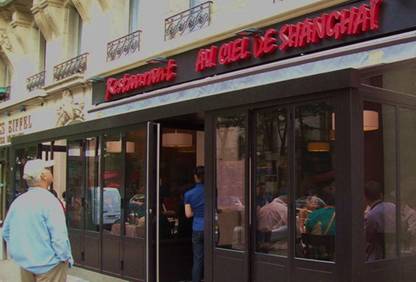
checks out the restaurant called Au Ciel de Shanghai on the avenue Suffren.
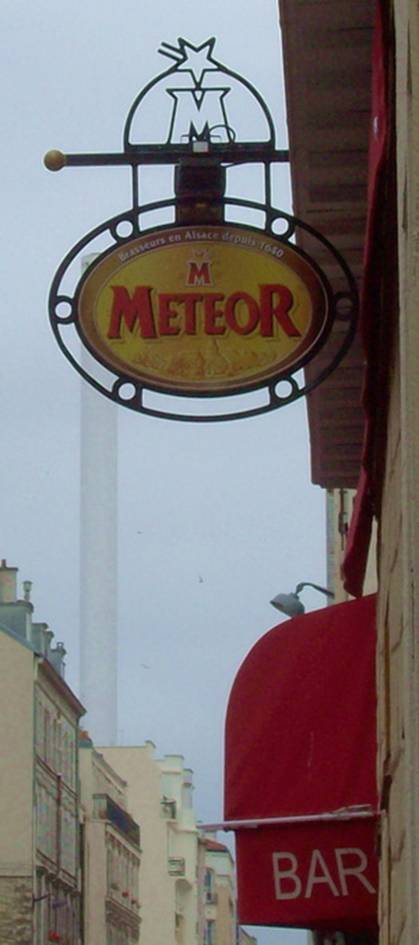
I
like this Alsacian beer sign on this bar on rue Fondary, a street that gets
its name from the fact that there was once a foundary there. Much of the upper part of the 15th
was once full of factories, including the factory where bleach was
invented.
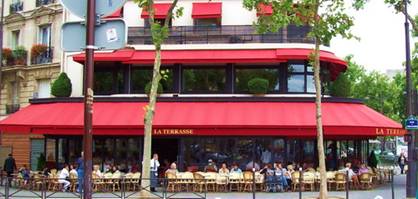
The
big brasserie called La Terrasse, caddy-corner across from the École
Militaire.
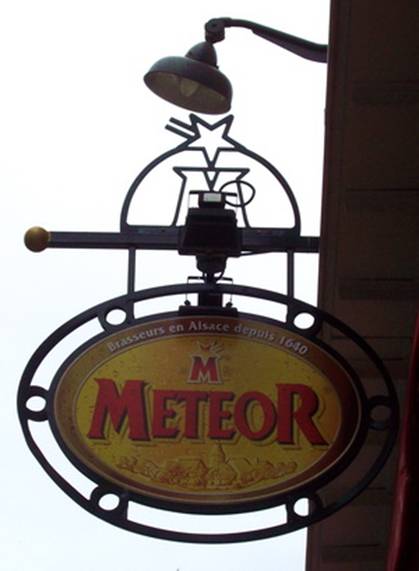
I
like the way street lights are often hung on the façades of buildings, eliminating
the clutter of poles along the street.
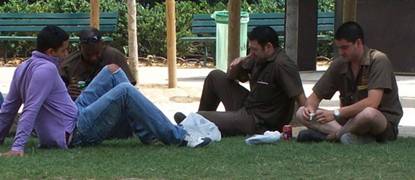
UPS
guys enjoying a leisurely lunch in the Marco Polo Gardens. Ah, summertime. |