Paris Journal 2009 – Barbara Joy Cooley Home: barbarajoycooley.com
Sign
my guestbook. View
my guestbook. ← Previous Next
→ Back to the beginning
|
Tom has been wanting to go to
what he calls “Mouse Mountain,” that is, Montsouris, for a while. Yesterday’s beautiful weather was a good
opportunity to take this long walk. We
started with our usual stroll through the Luxembourg Gardens all the way
through the Marco Polo Garden. As soon as we veered off on the
avenue Denfert-Rochereau, we were distracted.
The boutique called L’Artisanat Monastique was open for the first time
that we’ve ever seen. This is a place
that sells cute or tasty things made by monks and nuns who are affiliated
with St. Vincent de Paul. There are
laces, linens, tablecloths, bathrobes, leather goods, honey, jams, jellies,
chartreuse, mobiles, jewelry, and religious art. They say that soon they’ll be selling on
the web at www.artisanat-monastique.com
. I may go back and buy something for
the Zonta raffle basket. But we had a lot of walking to
do, so we didn’t buy anything because we didn’t want to carry it all that
way. We went on to the vast Place
Denfert-Rochereau and eventually made our way across it to the avenue René
Coty. I’d forgotten how pleasant this
avenue is for walking. There is a wide
center area for pedestrians, replete with trees and benches. It leads directly to the Parc Montsouris. When we reached the park, our
uphill walk was not over. We climbed
onward, toward the end of the park, to circle back around so that we could
see its lake. We exited the lovely park on
the avenue Reille and went up to the long rue de la Santé, which is home to
huge public hospitals, including the one where they take crazy
criminals. That one has a particularly
tall stone wall around it. Before that, though, we passed
Sainte-Anne’s hospital. It, too, has a
wall, but some of it has been removed to make way for a large, new round
hospital building that is currently under construction. I’m sure there is plenty of the
old Sainte-Anne’s left, however. If
you look at it on a map of Paris, it appears to be one huge building. In reality, it is a walled-in village of
buildings and gardens. I could only
catch glimpses here and there.
Someday, I’d like to see inside that wall. On the other side of the
street, we passed another institution that had been one of the first old
people’s homes, I think. Now it is a
big center for general practice medicine.
This is good to know in case we get sick. After passing yet another
enormous hospital called Cochin, we reached the boulevard Montparnasse where
we skipped over to the rue St. Jacques, which took us to the pleasant square
in front of Val de Grace, the stately military hospital. I like the rue Val du Grace
very much. It connects the hospital
entrance with the Marco Polo Garden, going through a charming
neighborhood. We ventured back through
gardens all the way home. This was a long walk, so in the
evening, we didn’t want to go far for dinner.
We went to the local Bistrot de la Grille Saint-Germain, where le patron was back from vacation at
last. This was the first we’d seen him
this summer. He recognized us, greeted
us warmly, told us to sit anywhere we wanted to, and said he’d bring us each
a kir on the house. How nice! I ordered the daily special, a blanquette de veau
(veal stew) with meat so tender it just fell apart. It came with a hearty creamy sauce with
vegetables mixed in it, and a side of basmati rice. Tom had the duck breast, with a rich, dark
sauce. We both ordered dessert: ice cream for Tom, and the crème brulée for me. I think I forgot to mention
that the night before, we had yet another fine meal at L’Abri Cotier: mignon
de porc for me, filet de boeuf
for Tom. There, too, we are recognized
and treated very, very well. Today, we left the apartment at
about noon and set about finding the places we want to see on the Journées du Patrimoine (Patrimony
Days) list. This event is something we
do every year. It happens on the third
weekend of September, and it is a chance to visit places that are not
normally open to the public. We saw four stately homes that
are now used for governmental purposes —all in the 7th
arrondissement. First was Hôtel de
Galliffet at 50 rue de Varenne. It is
the Italian cultural institute. Across
the street at number 50 was the Hôtel de la Rochefoucauld-Doudeauville, the
Italian Embassy, but it had a very long line so we did not go. We went up to the rue de
Grenelle to see the Hôtel D’Estrees, now the Russian Embassy, at number
79. It featured lots of wonderful
oriental carpets and some impressive 17th century highly decorated
rooms. Also on the rue de Grenelle at
number 85, we saw the Hôtel d’Avaray, the residence of the ambassador from
the Netherlands. It has a magnificent
collection of paintings, not to be missed.
Those Dutch masters are great.
Naturally, it was forbidden to take photographs or film in this
building. Back down on Varenne again, we
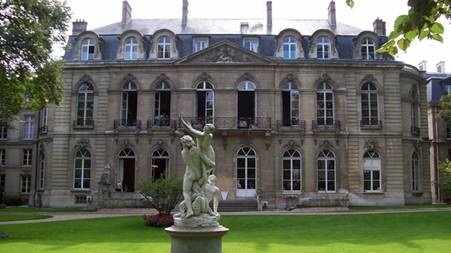
went to the Hôtel de Castries, at number 72.
Wow. This is the home of the
offices for the Minister of “L’Espace Rural et de L’Amenagement du
Territoire,” which is some kind of rural economic development office, as far
as I can tell, and the Secretary of State in charge of development for the
capital region. I so loved this
stately home. My heart ached when I
saw the poor condition of its graceful, unique windows. These must be restored, and soon, before
they rot! Finally, we visited the Hôtel
Villeroy, the sprawling headquarters of the Ministry of Agriculture at 78 rue
de Varenne. In these homes we saw 15th,
16th and 17th century tapestries from Gobelins and
Beauvais. We saw furniture from Louis
XIV, XV, and XVI periods. We saw
hundreds (it seems) of fine paintings.
There were lovely Aubusson and oriental carpets. And the gardens, oh the gardens,
they just went on and on. There is so
much greenery in the 7th arrondissement that you don’t see when
you walk along the streets, but believe me, it is back there, behind the
buildings, and there is more of it than you can imagine. On the rue de Varenne, especially, we could
see that each time we were in a great garden, that there were other great
gardens all around, up and down the street.
Gardens behind buildings on the rue de Varenne meet up with gardens behind
buildings on the rue de Grenelle. And
those two streets are not very close together! We were absolutely exhausted
after seeing these stately homes turned bureaucratic headquarters. We walked down to the rue Babylone to
escape the throngs of people going to Patrimony Days, only to find throngs of
other people out and about just because it was a gorgeous Saturday. At the corner with rue de Bac, we looked
into the window of the Café les Mouettes.
This is a place I’ve been wanting to try because it always seems to
have plenty of locals inside, and it is fairly inexpensive. We went in and had a superb
late lunch (4:30PM). I had the daily
special, a small filet of fish called “panga” which was served meunière-style. It came with a delicious gratin of broccoli and a tiny green
salad (13 euros). Tom had the country
terrine with a little green salad – very hearty and very good. This café has the feel of a
diner, not a bistro. It is small and
bright, on the busy corner across from the Conran store and the Bon Marché
department store. Service was
friendly, good, and fast, and the other diners (locals) were friendly, too. |
Saturday, September 19, 2009
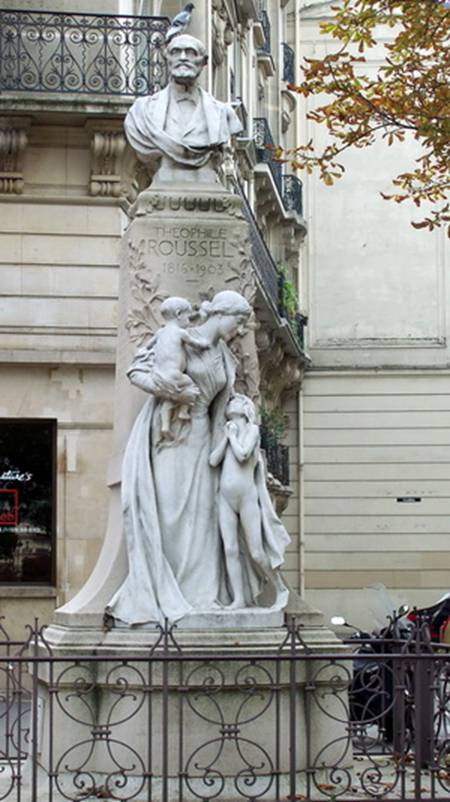
A
monument to Theophile
Roussel, on the avenue Denfert-Rochereau.
He was a politician and a doctor who is credited with eradicating
pellagra in France. That’s a vitamin
deficiency caused by lack of vitamin B3, aka
niacin.
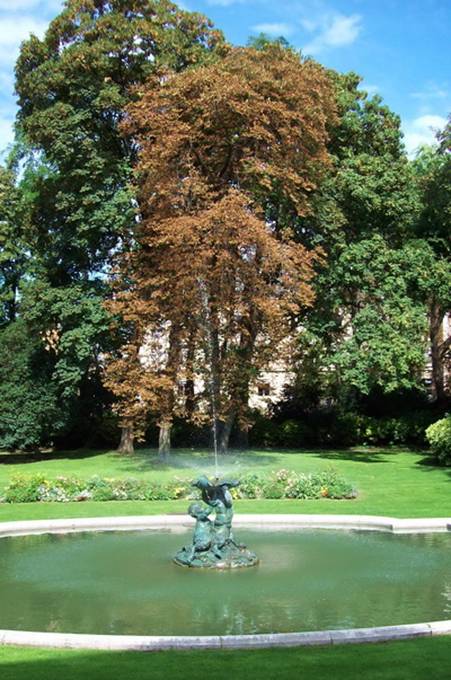
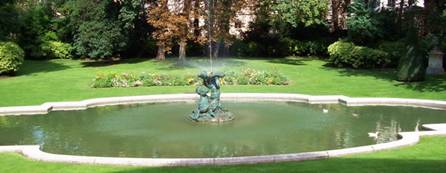
Garden
at the Hôtel de Castries on the rue de Varenne.
“Secret”
gardens separated by walls exist one after another after another behind
buildings on the rue de Varenne and the rue de Grenelle in the 7th
arrondissement.
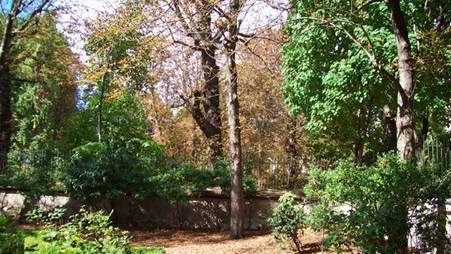
I
think this was the Hôtel D’Estrées, now the Russian Embassy. |