Paris Journal 2010 – Barbara Joy Cooley Home: barbarajoycooley.com
Photos
and thoughts about Paris
Sign
my guestbook. View
my guestbook. ← Previous Next → ← Go
back to the beginning
|
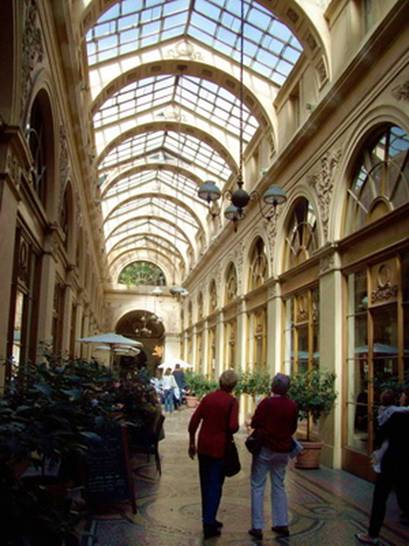
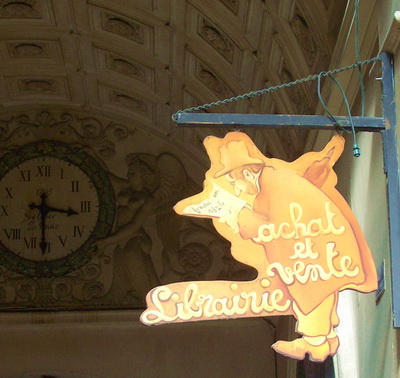
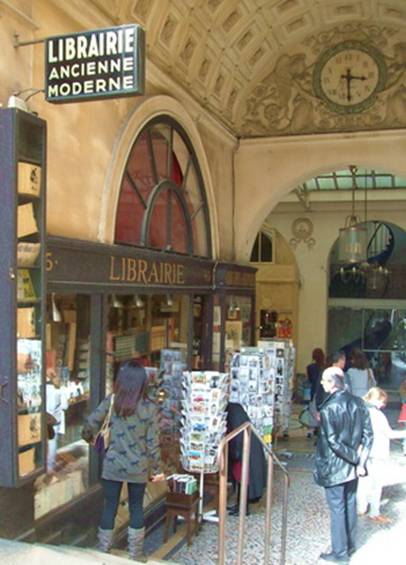
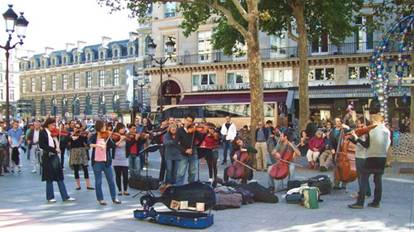
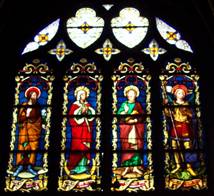
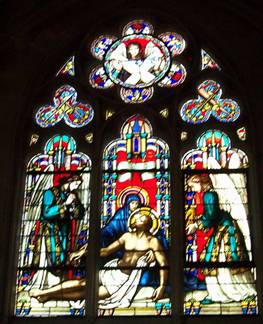
This past weekend was one of the best we’ve ever had in Paris. The weather was gorgeous. We had so many fun things to do, especially with Patrimony Days. As I wrote in Facebook yesterday, we saw the Banque de France, the Jardin du Palais Royale, the Oratoire de Louvre, the Saint Germain de l'Auxerrois church, and heard two fantastic opera singers performing for small change on the street and the grand organ at the Oratoire being played, and bought Limoges china from poor nuns. What a day! And I forgot to mention the superb chamber music ensemble playing Pachelbel's canon on the street near the Louvre and the Palais Royal. Plus, we explored the pretty and historic Galerie Vivienne. The Banque de France is the central bank of France. It is linked to the European Central Bank. The main task of the Banque de France is to implement the single monetary policy -- including interest rate policy -- within the framework of the European System of Central Banks. So of course when we entered the Banque de France we were given the opportunity to receive printed information in English, not just French, and it was very good English. As it should be, if the Banque is playing such an important role in the European Union, and in the world. The Banque actually occupies a number of buildings in Paris, but I believe this is the headquarters: the former Hôtel de Toulouse, circa 1640, purchased by the Count of Toulouse in 1713. It is all very grand, but the crown jewel of the building is the Golden Gallery, originally designed to house Louis Phélypeaux de la Vrillière’s collection of great Italian paintings. Its ceiling fresco, painted by François Perrier, is gorgeous. The décor is French Regency style. In addition to the Golden Gallery, we saw four other rooms on that level which were beautiful as well. Tom and I noted several important and old Kazak and other Caucasian rugs that could use a good cleaning. The Banque de France was created by Napoleon in 1800, and the Banque then bought the Hôtel de Toulouse in 1808. Other than needing to clean a few dingy-but-valuable rugs and a magnificent chandelier, we think the Banque is taking pretty good care of this historic monument. We did not get to see the souterrain (basement, which is a huge vault) where a phenomenal amount of gold bars are supposedly stored, but we did see a well-done exhibit about the souterrain which included, a secured glass case, one gold brick and one gold bar. Tom and I do not believe that France really has all that gold stored there, in the middle of Paris. No way. Near the Banque de France is the old building for the Bibliotheque Nationale de France (BNF), or the French National Library. Plans were to include this library and its great meeting room in the Patrimony Days openings, but the renovation work going on there just could not be completed in time. Too bad. But at least the library will be open at other times, following the renovation. Instead, we visited the Galerie Vivienne, one of many old-fashioned covered/enclosed shopping galleries in Paris. This one still has all of its old charm, and it managed to escape demolition that was planned for it at the beginning of the 20th century. In 1961, renovation work began, to prevent the collapse of its glass dome. In 1974, following a demonstration in support of 19th century architecture, the Galerie Vivienne was listed in the Inventory of Historic Monuments and plans were made for its complete restoration. It was never completely let go. It always attracted artists, writers, and other creative types who liked its rich past and its “parfum balzacien.” Colette frequented the bookstore there; she lived nearby in an apartment over one of the Palais Royal’s galleries of shops. The designer Kenzo made his first fashion show in Galerie Vivienne in 1970. Later, in 1986, Jean-Paul Gaultier arrived, consecrating the Vivienne most definitively as a high place in the Paris fashion world. We finally left the Galerie Vivienne after exploring it thoroughly, and we headed over to the Jardin du Palais Royal. There, in the covered opening leading to the garden, we heard a magnificent male voice singing opera – Tosca, to be specific. We reached the passageway and stood, listening, along with about 50 other passers-by. He was great. We moved on, but while we were walking along an allée of pruned chestnut trees, we heard a woman’s voice singing opera. We went back. There she was. There were two of them, poorly dressed, singing with great volume and perfection. Their voices were so strong, in fact, that they scared one little girl to the brink of tears. The singers had an upturned hat set out on the pavement before them to collect coins from all of us. Now why would two such talented people have to perform on the street for change? Is the economy so bad that great opera singers are now impoverished? I don’t think this couple was French. I detected some kind of accent in their spoken French, but I’m not sure what it was. We gave them some change, and moved on with our adventures. At the far end of the Jardin du Palais Royal, we saw a very long waiting line of people going to visit the Palais Royal itself for Patrimony Days. We’ll do that in another year, we thought, starting in the morning before the masses arrive. Upon exiting the Palais Royal’s courtyard at the Place du Palais Royal, we were surprised once again. There was a very professional sounding chamber music ensemble playing Pachelbel’s Canon and trying to sell their CDs. What lovely music! After listening, we walked on to the Oratoire du Louvre, which is now used as a Protestant church. As far back as 1791, the Protestants of Paris held their meetings in the church of Saint Louis du Louvre. When plans were made to demolish that church, Napoleon I decided to let the Protestants use the Oratoire du Louvre instead, starting in 1811. Reportedly, the pastor then had a choice of either the austere, humble Oratoire, or the elaborate, imposing church of Madeleine. Being a Protestant, he chose the less ostentatious Oratoire. The Oratoire church was originally built in 1621, for the order of Oratorians who’d been at Val de Grace. The façade was not completed until 1745. Louis XIII made the Oratoire a royal chapel in 1623, so of course it was heavily vandalized in the revolution in 1792. So when the Protestants took it over in 1811, it was in very bad shape. Even though they didn’t get full attribution of the building until 1844, the Protestants set to work right away. (Protestant work ethic?) The Oratoire’s great organ was installed in 1828. In 1882, the Oratoire was one of eight Protestant parishes in Paris. We continued along the rue Saint Honoré, noting all the unexpectedly reasonably priced menus posted at numerous restaurants along the way. You can still get a coffee and a croissant for 1.50 euros in the center of Paris, at a number of places. We went into a little network of streets across from the end of the Louvre, where the grand church of Saint Germain de l’Auxerrois is located. As we walked by what looked like convent buildings next to the church, an older nun came out and tried to hustle us. I’ve noticed people who dress like nuns and who then beg on the street, so I ignored her. But Tom stopped to listen to her. He later said, “When a nun tells you to do something, you do it. I had to stop and listen; she’s a nun.” I said, “You do not have to. You’re Protestant, not Catholic.” He said, “I’m catholic with a small ‘c’.” She was hustling all right, but not for herself. The nuns were holding a “vide-grenier,” or garage sale, in part of what was once a convent or monastery building, but is now used by the Prefecture of Police whose headquarters are nearby on the Ile de la Cité. The prefecture evidently decided to allow the nuns to use the building for their garage sale on Patrimony Days weekend so that they could raise some money for the “Village Renaissance,” a Center of Reinsertion for Those Leaving Prison. Aha. We believe it is illegal for charities to solicit donations from foreigners in France. But this way, by selling something to us, they can still raise money from us foreigners. Very clever. Tom initially was going to buy just a one-euro pair of old wood castanets. But then he saw a Limoges porcelain coffee pot and covered sugar cube bowl. Oh no. He turned one piece over, and I confirmed that this was a 19th century mark on the bottom. The price was only 30 euros for the set. Tom could not resist. We need more Limoges porcelain decorated with little pink flowers like we need a hole in the head, and we certainly don’t need Limoges here in a rented apartment. But he bought the set anyway. At least he doesn’t spend money on playing golf or drinking at bars. At the time, we thought the money was just for the nuns to spend or give away as they saw fit. We didn’t read the photo of the garage sale flyer that I took until today. At least the money went to a good cause. The nun hustling out on the street was doing a good job. The garage sale room became crowded with shoppers, so I went out to wait in the shady courtyard while the nuns packed up Tom’s purchase. Then we went in to visit the church itself. It has magnificent windows, some circa 1570. Its chapel dates back to the 13th century, and much of the rest of it was built in the 14th and 15th centuries. The bell of the church, circa 1529, has a bloody significance. When it was sounded to call people to the Matins on the feast of Saint Bartholomew on August 24, 1572, that sound was used as the signal to the Guisard (mob of Parisians) to begin the killing of thousands of Protestants who were in town for a wedding. This murderous rampage was known as the Saint Bartholomew Day massacre. It is a wonder there are any Protestants left in France. This church was closed during the Revolution and used for non-church purposes, until 1837. Finally, very sore from walking, we crossed back over the Seine on Pont Neuf and trudged down the rue Dauphine toward home. We rested and read, and then, finding that Le Café Tournon was closed for Sunday, we went for a very simple dinner at Café Mondrian. In the evening, we listened to jazz CDs and learned to play the castanets. Sign
my guestbook. View
my guestbook. Note: For addresses & phone numbers of
restaurants in this journal, click
here. |
Monday, September 20, 2010
One
of the English brochures we were given at the Banque de France.
The
Galerie Vivienne in the 1st arrondissement, near the Banque de
France and the Bibliotheque Nationale de France.
The
very popular bookstore in the Galerie Vivienne.
Pachelbel’s
canon being performed on the Place du Palais Royal.
The
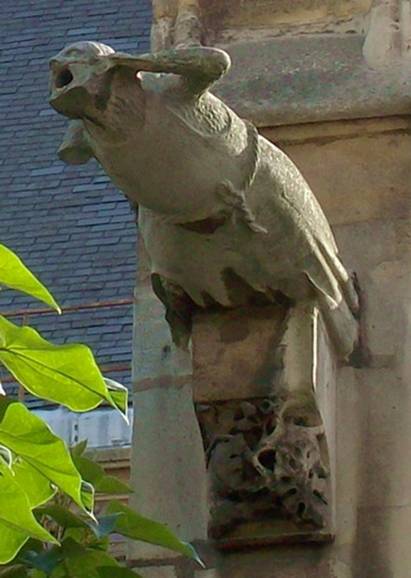
church of Saint Germain de l’Auxerrois has a number of screaming male
gargoyles.
Windows of the Saint
Germain de l’Auxerrois church.
And here’s the 2009 Paris Journal. |