Paris Journal 2008
Sign
my guestbook. View
my guestbook. ←Previous Next
→ Barbara’s home page
|
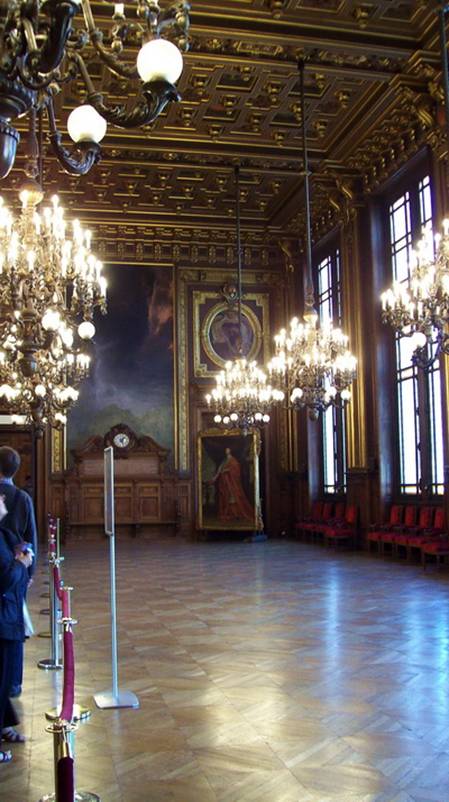
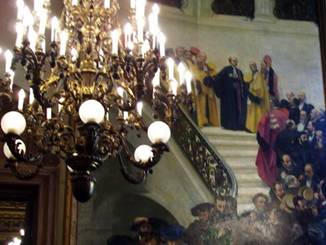
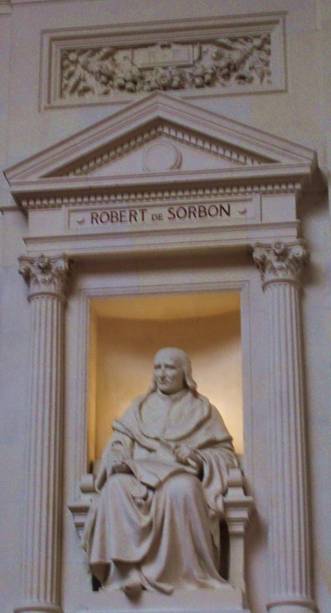
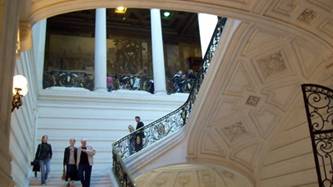
We started out yesterday with a mad dash at Champion. This grocery is open on Sunday mornings until 1PM, and we thought it might be a quiet time to go there. Wrong! It was full of frenzied Parisians trying to do all of their weekend chores and errands. Early in the afternoon, we started out on day two of Patrimony days. First on the list was the Sorbonne. Of course we must see the Sorbonne, Tom and I who worked for so many years for a large university! It was surprisingly and stunningly beautiful. We did not enter through the famous entrance at the Place de la Sorbonne. Instead, the guide for Patrimony Days gave the rue des Ecoles address for the starting point. We were surprised at the grandness of this entrance. Inside was a beautiful peristyle with two great staircases. So many of the buildings that comprise the University of Paris look somewhat shabby. That’s why we were stunned to see how beautiful this one is, and how perfectly maintained and restored it is becoming. The chapel is still undergoing restoration, so we did not see it. The Collège de Sorbonne was one of the first colleges that made up the medieval University of Paris. It was founded by Robert de Sorbon in 1257. The university is actually about a hundred years older than that. There were seventy or so colleges in the university in medieval times, but most did not survive. The Sorbonne almost did not – it was “suppressed” during the Revolution. Eventually, it became the theological college of the university. The university re-organized itself in 1970, as universities are prone to do. After that, four colleges came to use “Sorbonne” somewhere in their names, but the word no longer refers to a single college. Instead, “La Sorbonne” is the historic building that we visited on Patrimony weekend. At the top of the peristyle were entrances to a hall that connected several formal and lovely rooms, including the Grand Salon, part of which is shown below.
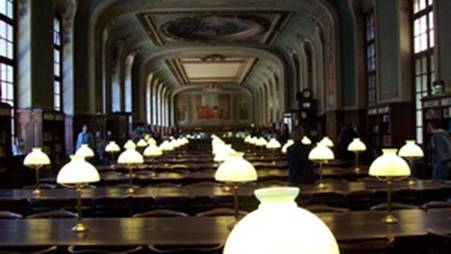
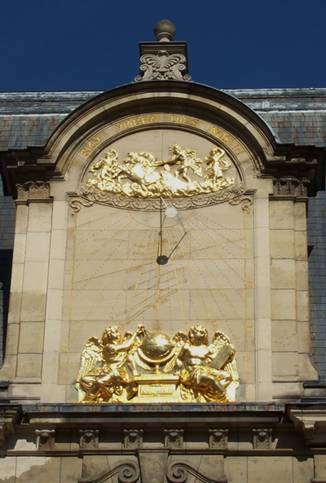
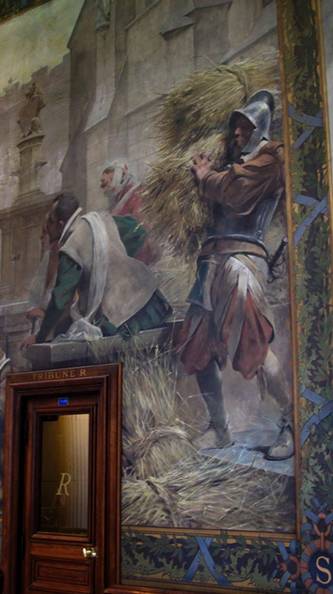
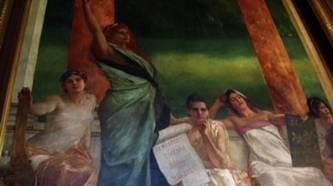
The upstairs part of the peristyle has impressive, large murals on the walls, including one that shows scholars in ancient times, studying on the top of the Montagne St. Genevieve, the general area of the heart of the university today. On the other side of the peristyle from these beautiful rooms was a grand amphitheater. After we took that in, we went out to the sunny Cour d’Honneur, which we remember fondly from French in Action video lessons. There is an impressive sundial mounted high at one end of the courtyard. Next we were directed to the Library. What a fine library, with a grand and appropriate reading room! This is what a university library should look like. And it is a real, working library, with millions of documents. We were able to peek through an open door to see the work-a-day stacks. But the reading room, below, is my favorite.
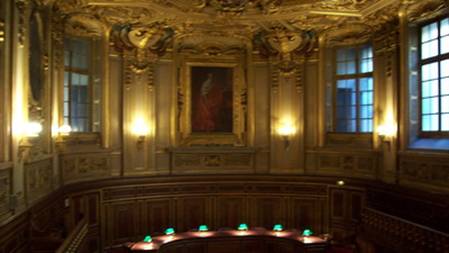
One of the bookcases on the side was for English language reference books. Included were the famous old Fowler guides. We thought it might be fun to slip one of Tom’s Norton Sampler books in there. (Yes, we will be updating the Sampler soon, and that will be the seventh edition.) After the library was yet another amphitheater (below), this one named after the treacherous Cardinal Richilieu. His larger than life image, repleat with red robe, takes up a big space in the center. (Sorry about the blurriness; flashes were not allowed, and I wouldn’t use one anyway in a place like this with so many other people. It can be really obnoxious to have lots of flashes flashing.)
We had planned to see the Lycée Henri IV after the Sorbonne, but when we saw the long line of people waiting to get in, and the fact that the line was not moving, we said no, not now, now way. This is a very historic and important site in Paris, and now it is a school that many important people have attended. So everybody wants to see it. Instead, we visited the St. Etienne du Mont church across the street, and then went down the rue des Carmes, back to the rue des Écoles, to have a very late lunch at Pescatore, an Italian restaurant that is open every day and will serve lunch in mid or late afternoon, if you’d like. My lunch (lasagna, a small portion) was good, but Tom’s (spaghetti with meat sauce) lacked sauce. We went back up the hill after lunch to see if the Lycée line was shorter. It was not. So we went back down the hill. Tom was then in the mood to see another cloister-like garden, so I checked the guide to see if the garden at the Hôtel Dieu might be included in Patrimony Days. It was not. We went anyway. You can imagine how busy the square in front of Notre Dame is on a beautiful Sunday. The Hôtel Dieu faces this same square; as I’ve said before, it is a big and very old public hospital. It also has a small hotel in its upper floors somewhere, and it has a garden that we had not yet seen. We walked into the main entrance. There was a receptionist seated behind a long desk, and at the other end of the long desk were two security guards in sharp-looking dark blazers, white shirts, and ties. A young man was ahead of me, speaking to the receptionist. She was shocked to learn that his friend had managed to slip by her and was in a part of the hospital where he was not supposed to be. Instead of dispatching one of the security men to go after him, she took off after him herself. I thought that was odd. So, she was gone. I approached the security men and asked, in my best, polite French, “Please, sir, is there a garden that is open to the public?” He answered with a welcoming smile, that yes, it was around the corner to the left. He should be the receptionist and she should be the security guard, I thought. I smiled and thanked him, and in no time at all, we were in a beautiful, formal French garden – one of the nicest ones of that size that I’ve ever seen. After a pleasant self-guided tour of the garden, we started for home. Passing by the old St. Severin church in the Latin Quarter without stopping in is impossible for us. So we entered, and we found that its cloister-like garden was open for Patrimony Days. We finally made it back to the apartment for a rest. I suddenly had the urge for Indian food. Usually, Tom comes up with some excuse or reason why we can’t go for Indian food, so I haven’t had any for a few years. That’s too long. I love Indian food. On the internet, I learned that the restaurant that some people consider to be the best Indian resto in Paris (and some say in Europe!) is right here in the 6th arrondissement: Yugaraj, at 14 rue Dauphine (tel. 01-43-26-44-91, www.yugaraj.com ). Surprise! Tom said yes, we could go. From my internet searching, I knew that it would not be cheap. Tom said he never wants to eat cheap Indian food. Good. I told him that some American family wrote that they didn’t like the place, in part because they did not provide a high chair for their little one. Tom said that he likes the idea of restaurants that don’t accommodate little ones. Good. I called and reserved a table for 8:30PM. Some Americans had written that they thought the service at Yugaraj was arrogant. I think that many people expect Indian restaurants to be as informal as many Chinese or even Thai restaurants are. But they generally are somewhat formal. Yugaraj certainly is. The servers all wore formal white shirts with black bow ties, and black suits. It is not a large restaurant, and the décor is not over the top as it is in some Indian restos. This one has been here for a long time, I think, and its décor is really quite subtle and French. The dinner plates were beautiful – they looked like Villeroy & Boch, but I didn’t turn one over to see if it was. As we sat there, the place filled up, but it was not crowded. The tables are not crowded together, as they are in so many Paris bistros. We were given a prime spot at the front, in one of two bay windows. A glass-and-wood divider separated us from the rest of the room, so it was almost like having our own tiny private dining room. At the other end of the room was a big group of English speaking people, not all Americans, and they seemed to be people who live in Paris. They were celebrating someone’s birthday. For starters, we ordered garlic nan and vegetable samosas. The samosas were only two – a very small course. The garlic nan was probably the best I’ve ever had. Then we each had a main course of lamb korma, which this resto called “Ghost korma.” Tom said it was the best korma sauce he’s ever tasted. I am not sure whether it is best, or second best (the best being perhaps at the Indian Oven in Columbus, Ohio). The rice was incredibly good. It had some cashews in it, and a few bits of fresh shrimp, and other good things. I ordered a very good wine, a white Sancerre, which complemented the food perfectly. One of our servers was shy, and so I guess I can see how some people might interpret that as arrogance. We did not. The other servers were friendly enough and all were efficient. During dinner, a very tall and elegant white-haired, dark Indian/French man entered. He was clearly the boss. There was an unfortunate misunderstanding or disagreement between the boss and the large birthday group. The group had spent a lot of money, including money for expensive champagne. They’d brought in a customized birthday cake, I assume with permission from the restaurant. They were charged an exorbitant amount for the cake to be served to them. They were not happy. I think the boss was not happy that they’d sung “happy birthday,” even though they did so quietly. A “discussion” was held. Eventually, apologies were made all around, but the faces of the people in the group did not look happy as they left the restaurant after the party was over. That’s too bad. Arrogance? Maybe. I don’t know. But our experience was good. I’d recommend Yugaraj, but don’t take your kids there and don’t celebrate your birthday there. Dress nicely, consider it to be an elegant night out, and enjoy the food. |
Monday, September 22, 2008
Looking across the peristyle after we climbed one of
the grand staircases.
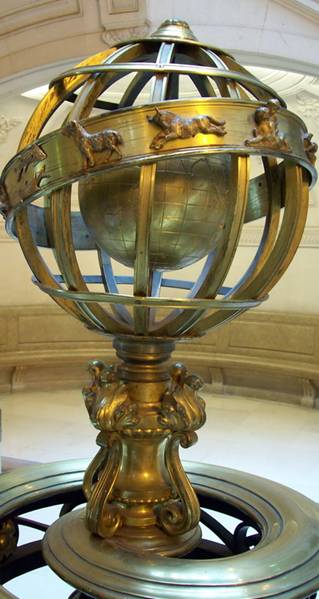
The finial at the base of the staircase that we took to
climb up to the main level of the Sorbonne was a globe with the signs of the
zodiac around it.
There was a painting of people on the same staircase in
one of the grand rooms upstairs. Sundial in the Cour d’Honneur reads one o’clock, but it
was really two o’clock due to Daylight Savings Time (below).
The Grand Amphitheater at the Sorbonne.
The founder of the Collège
de Sorbonne.
One of the two staircases in the peristyle at the
Sorbonne.
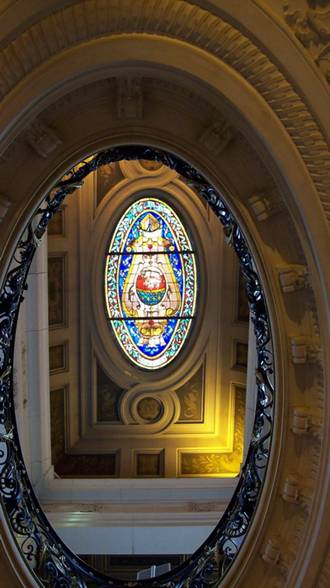
The center of the Sorbonne’s peristyle is topped by a stained
glass window featuring the Paris coat of arms. Coats of arms for other university cities
in France decorated the banisters of the staircases. a A part of one of the large murals in the upper part of
the peristyle. Another, below.
|